Common wired interfaces play a vital role in robotics, electronics, and industrial automation by enabling reliable communication between sensors, controllers, actuators, and computers. A wired interface defines the physical connection and communication rules that allow data to be transferred in a stable and predictable way. Compared to wireless communication, wired interfaces offer higher reliability, lower latency, better noise immunity, and greater security. For this reason, most robots and embedded systems still depend heavily on wired communication.
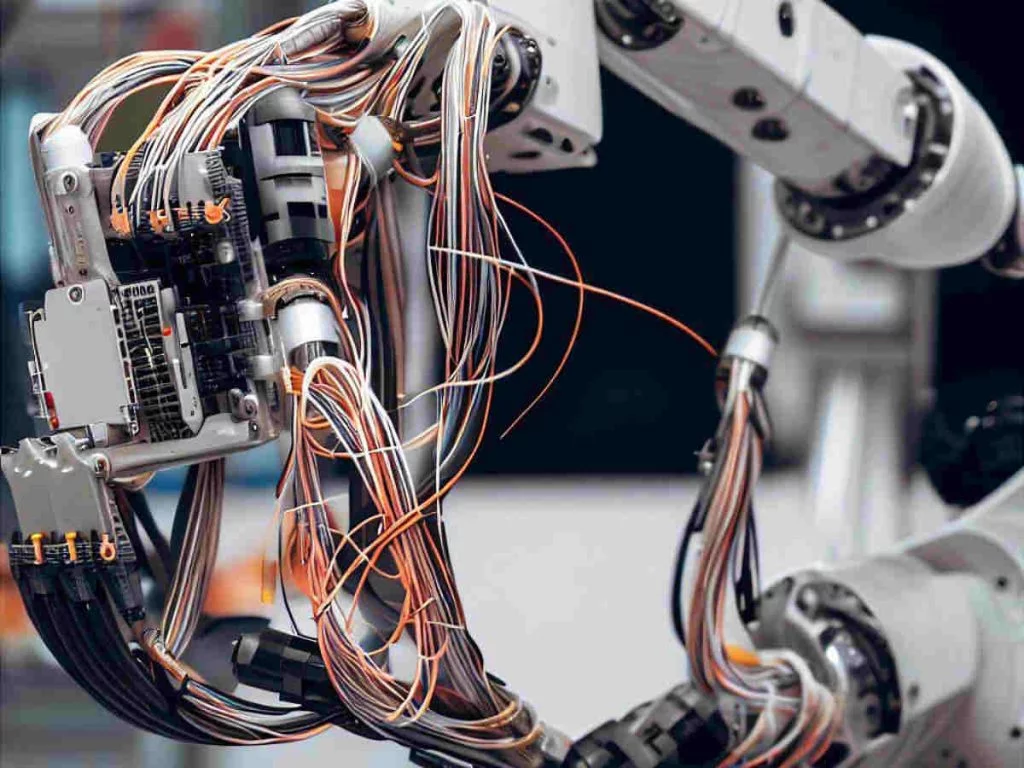
One of the most basic wired interfaces is GPIO (General Purpose Input/Output). GPIO pins are used for simple digital communication where the signal is either HIGH or LOW. They are commonly used to read data from switches, limit sensors, and encoders or to control LEDs and relays. GPIO is easy to use and requires minimal hardware, but it is not suitable for high-speed or complex data transmission.
The UART (Universal Asynchronous Receiver/Transmitter) interface is one of the most widely used serial communication standards. It uses two main lines: TX (Transmit) and RX (Receive). UART is simple, low-cost, and commonly found in GPS modules, Bluetooth modules, RFID readers, and debugging systems. Its main limitation is that it usually supports only point-to-point communication and has limited speed compared to modern protocols.
Another popular interface is I²C (Inter-Integrated Circuit). It uses only two wires: SDA (data) and SCL (clock), and allows multiple devices to connect on the same bus using unique addresses. I²C is ideal for short-distance communication between low-speed devices such as temperature sensors, accelerometers, pressure sensors, and display modules. It is widely used in robotics because it reduces wiring complexity and supports multiple peripherals.
The SPI (Serial Peripheral Interface) is a high-speed communication interface that uses four main lines: MOSI, MISO, SCK, and CS. SPI is faster than I²C and is commonly used for devices that require rapid data transfer such as camera modules, high-speed ADCs, memory cards, and displays. Its drawback is that it requires more wires and separate chip select lines for each device.
USB (Universal Serial Bus) is another important wired interface, especially in advanced robotics and computer-connected devices. USB supports high data rates and plug-and-play functionality. It is commonly used for cameras, LiDAR systems, robotic arms, and microcontroller programming. USB can supply both power and data, which simplifies system design.
For industrial and long-distance communication, RS-232 and RS-485 are widely used. RS-232 is suitable for short-range communication and is simple to implement, but it is sensitive to noise. RS-485, on the other hand, uses differential signaling, which makes it highly resistant to electrical interference and suitable for long distances and multiple devices on the same line. It is commonly used in industrial sensors and control systems.
The CAN Bus (Controller Area Network) is a robust wired interface originally developed for automotive systems. Today it is widely used in robotics and automation. CAN allows multiple devices to communicate on the same bus with high reliability and built-in error handling. It is ideal for real-time control systems where safety and accuracy are critical.
Ethernet is used in robots that require very high data rates and networking capabilities. It is common in machine vision systems, collaborative robots, and factory automation. Ethernet allows robots to connect to networks, servers, and cloud systems for data processing and monitoring.
In summary, common wired interfaces such as GPIO, UART, I²C, SPI, USB, RS-232, RS-485, CAN Bus, and Ethernet form the backbone of communication in robotic and embedded systems. Each interface has its own advantages and is selected based on speed, distance, complexity, and reliability requirements.