Communication protocols define the rules and standards that allow different robotic components to exchange data accurately and reliably. In a robot, many parts must work together, such as sensors, microcontrollers, motor drivers, cameras, and computers. Without communication protocols, these components would not understand how to send, receive, or interpret data. A protocol specifies how data is formatted, how fast it is transmitted, how errors are detected, and how devices coordinate with each other. In simple terms, communication protocols act like a common language that robotic components use to communicate.
In robotics, communication protocols are essential for synchronization and coordination. For example, when a distance sensor detects an obstacle, it must send this information to the controller in a predefined format. The controller then processes the data and sends commands to the motor driver to stop or change direction. If the protocol is not correctly defined, the data could be misinterpreted, leading to incorrect robot behavior.
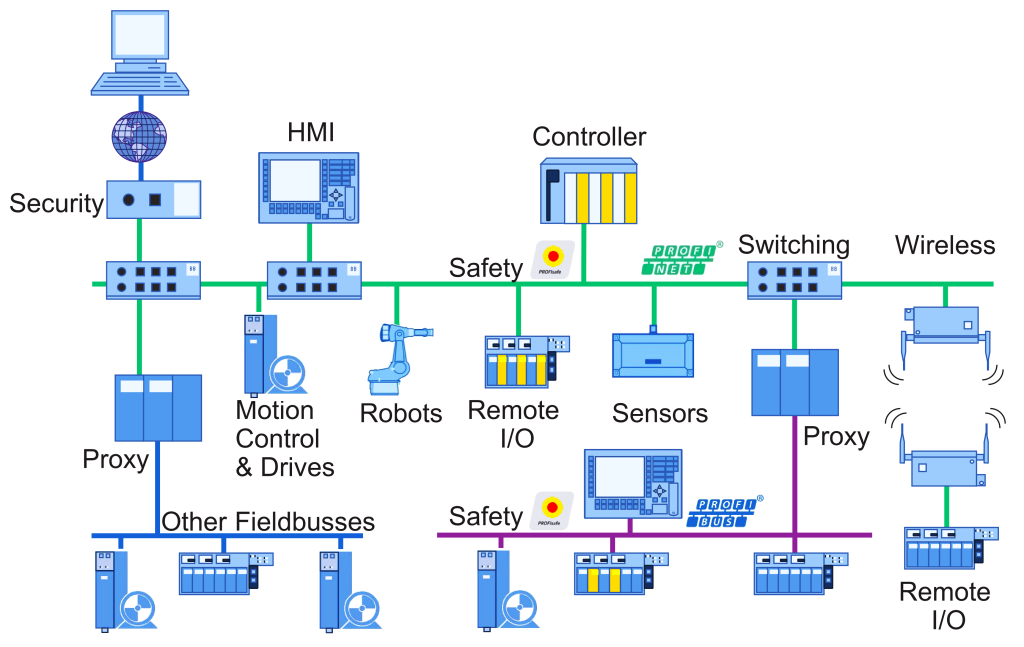
One of the most common communication protocols is UART (Universal Asynchronous Receiver/Transmitter). It is simple and widely used in robotics for communication between microcontrollers and external devices such as GPS modules, Bluetooth modules, and RFID readers. UART defines how data bits are transmitted serially, including start bits, stop bits, and parity for error checking. For example, a GPS module may send location data to a robot controller using UART, allowing the robot to navigate accurately.
Another important protocol is I²C (Inter-Integrated Circuit). It is designed for communication between multiple low-speed devices using only two wires. I²C defines addressing, data transfer, and acknowledgment mechanisms. In robotics, I²C is often used to connect sensors like temperature sensors, accelerometers, gyroscopes, and pressure sensors to a microcontroller. For example, an IMU (Inertial Measurement Unit) uses I²C to transmit orientation and motion data to the robot’s processor.
SPI (Serial Peripheral Interface) is a high-speed communication protocol used when fast data transfer is required. It uses a master-slave architecture and separate lines for data transmission and clock signals. SPI is commonly used in robotics for camera modules, memory cards, and high-speed ADCs. For example, a robotic vision system may use SPI to quickly transfer image data from a camera sensor to the controller.
In industrial and mobile robotics, CAN Bus (Controller Area Network) is widely used because of its reliability and real-time performance. CAN defines message prioritization, error detection, and fault tolerance. It allows multiple devices to communicate over the same bus. For example, in an autonomous vehicle robot, sensors, motor controllers, and braking systems can all communicate using CAN Bus, ensuring safe and synchronized operation.
For longer-distance and noise-resistant communication, RS-485 is commonly used. It uses differential signaling and supports multiple devices on a single communication line. In factory robots, RS-485 is often used to connect distributed sensors and actuators across large areas.
At a higher level, Ethernet-based protocols are used in advanced robotics and automation. Ethernet allows very high data transfer rates and network connectivity. For example, machine vision systems use Ethernet to send high-resolution images from cameras to processing units. Protocols such as TCP/IP and UDP define how data is packaged and transmitted over networks.
Another example is USB (Universal Serial Bus), which is used for plug-and-play devices such as cameras, LiDARs, and robotic controllers. USB defines power delivery, data speed, and device identification, making it easy to integrate peripherals into robotic systems.
In conclusion, communication protocols define the structure, timing, and reliability of data exchange between robotic components. Protocols such as UART, I²C, SPI, CAN, RS-485, USB, and Ethernet ensure that sensors, controllers, and actuators can communicate effectively. By following these rules, robotic systems achieve accurate data transfer, coordinated actions, and stable performance in real-world applications.