Actuators in Robots: Motors and Servos
Definition
In robotics, actuators are components that convert electrical, hydraulic, or pneumatic energy into physical motion. They are the “muscles” of a robot, responsible for moving joints, wheels, arms, grippers, and other mechanical parts. Among the most commonly used actuators in robots are motors and servos. Motors provide continuous rotational motion, while servos offer precise control over position, speed, and torque. Without actuators, a robot would only be able to sense and compute, but not act on its environment.
Engineering Perspective
From an engineering point of view, actuators are selected based on factors such as torque, speed, accuracy, efficiency, size, and power consumption.
- DC motors are simple, low-cost, and widely used for driving wheels and fans. Their speed can be controlled by varying voltage or using pulse-width modulation (PWM).
- Stepper motors move in discrete steps, making them suitable for applications that require precise position control without complex feedback systems.
- Servo motors combine a motor, gearbox, position sensor, and control electronics into one unit. They operate in a closed-loop system, meaning feedback is constantly used to correct position or speed.
Engineers must also design appropriate motor drivers, gear systems, and control algorithms to ensure smooth and reliable motion. Heat dissipation, mechanical stress, and energy efficiency are key design concerns, especially in mobile or autonomous robots.
Real-Life Examples
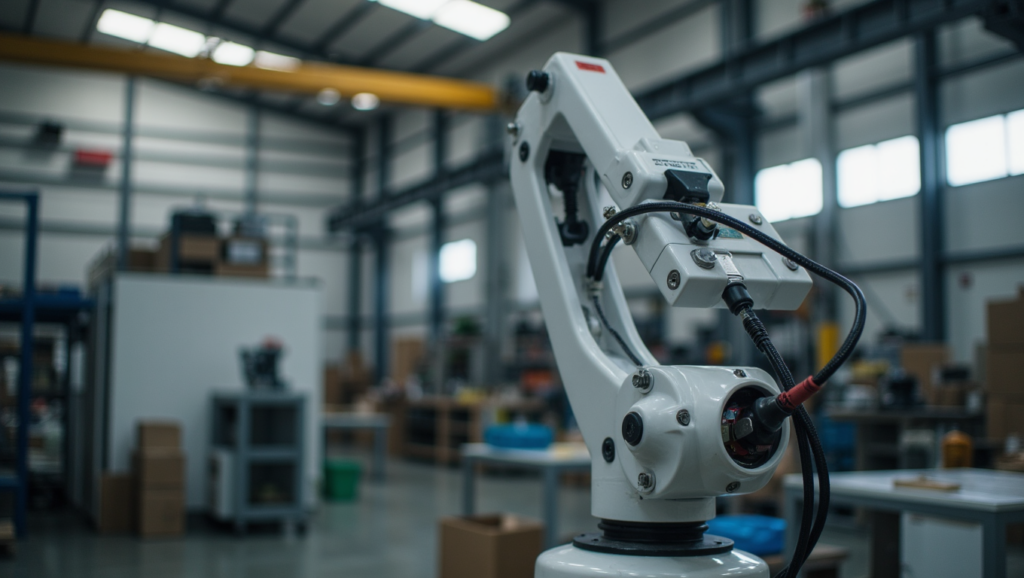
Actuators are present in many real-life robotic systems. In a robotic arm used in automobile factories, servo motors precisely control joint angles to weld, paint, or assemble parts. In robot vacuum cleaners, DC motors drive the wheels and suction fan, allowing the robot to navigate rooms and clean surfaces. Humanoid robots use multiple servos to mimic human-like movements such as walking, waving, or gripping objects. Even everyday devices like automatic doors and camera gimbals rely on motors and servos for smooth and controlled motion.
Applications in Robotics
Motors and servos play a vital role across different robotic applications. In industrial robotics, high-torque motors enable lifting heavy loads and performing repetitive tasks with high accuracy. In medical robotics, tiny and highly precise actuators allow robotic surgical tools to make delicate movements, improving patient safety. Educational and hobby robots commonly use servo motors for simplicity and ease of control, helping students learn motion control concepts. In autonomous vehicles and drones, actuators control steering, propulsion, and stabilization, directly affecting performance and safety.
Conclusion
Actuators such as motors and servos are fundamental to robot operation, transforming control commands into physical action. Through careful engineering design and proper selection, these components enable robots to move efficiently, accurately, and reliably. Whether in factories, homes, hospitals, or classrooms, actuators make robotics practical and impact in the real world.