What is adaptive behaviour ?
Definition
The ability of a robot to improve its performance refers to its capacity to learn from experience, data, and feedback, and then adjust its behaviour to perform tasks more efficiently, accurately, or safely over time. This capability is a core aspect of intelligent robotics and is often called robot learning or adaptive behaviour. Instead of being limited to fixed, pre-programmed instructions, such robots analyse past actions and outcomes to reduce errors, optimise movements, and make better decisions in future situations.
Engineering Perspective
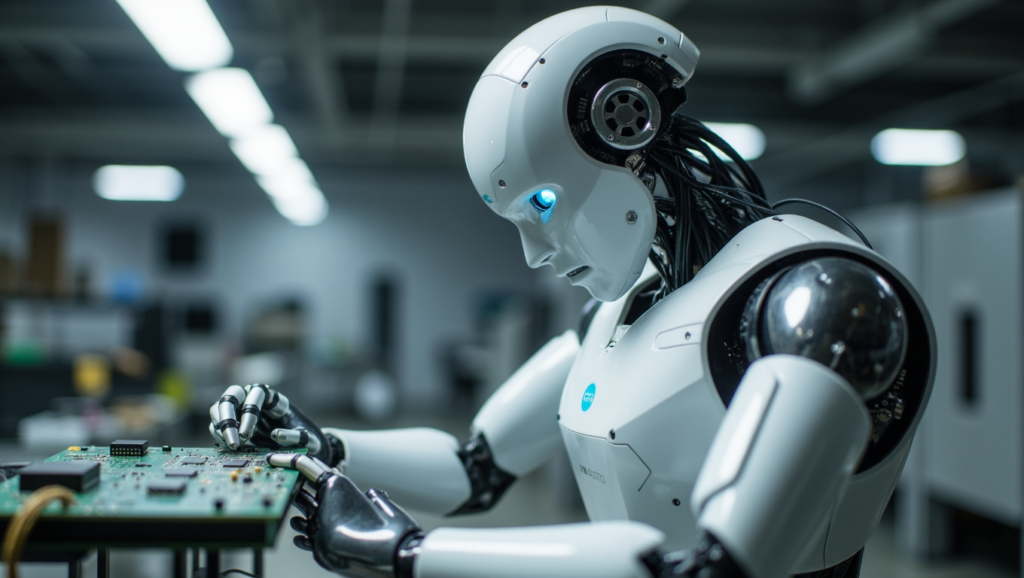
From an engineering standpoint, performance improvement in robots is achieved through the integration of sensors, control systems, data processing, and learning algorithms. Sensors such as cameras, force sensors, lidar, and encoders continuously collect information about the robot’s environment and its own actions. This data is processed by onboard computers or cloud-based systems. Learning techniques—such as supervised learning, reinforcement learning, and adaptive control—allow the robot to update its internal models. For example, in reinforcement learning, a robot receives rewards or penalties based on its actions, gradually learning which behaviors lead to better outcomes. Engineers also design feedback loops where performance metrics like speed, accuracy, energy consumption, and error rates are monitored and used to fine-tune control parameters. Together, hardware reliability and intelligent software enable robots to self-improve during operation.
Real-Life Example
A practical real-life example can be seen in industrial robotic arms used in manufacturing. Initially, a robot may take a longer time to assemble a product or may apply inconsistent force. Over repeated cycles, the robot collects data on torque, position accuracy, and task completion time. By analyzing this data, the system learns to optimize joint movements, apply the right amount of force, and reduce unnecessary motions. As a result, the robot becomes faster and more precise with fewer defects. Another example is robotic vacuum cleaners, which learn the layout of a home over time and improve their cleaning routes to avoid obstacles and cover areas more efficiently.
Applications
The ability of robots to improve their performance has wide-ranging applications across many sectors. In healthcare, rehabilitation robots adapt to a patient’s progress, gradually adjusting assistance levels as the patient regains strength or mobility. In autonomous vehicles and mobile robots, learning improves navigation, obstacle avoidance, and energy efficiency in changing environments. In agriculture, robots learn optimal harvesting patterns and adjust to different crop conditions. Service robots in hotels or warehouses improve task scheduling and human interaction through experience. In space exploration, robots that can learn and adapt are especially valuable, as they must operate in unknown and unpredictable conditions with limited human intervention.
Conclusion
The ability of a robot to improve its performance transforms it from a simple automated machine into an intelligent, adaptive system. Through engineering design that combines sensors, learning algorithms, and feedback control, robots can continuously refine their actions. This capability leads to higher efficiency, reduced errors, and greater flexibility, making adaptive robots essential for modern industry and future technological advancements.