AI-Based Decision-Making Models
Understanding intelligent decision systems for modern robotics and autonomous machines
AI-Based Decision-Making Models are computational approaches that enable machines, robots, and intelligent systems to evaluate information, predict possible outcomes, select actions, and adapt their behavior according to changing conditions. These models combine artificial intelligence with data processing, learning algorithms, optimization, probability, and logical reasoning to support autonomous decision-making.
In robotics, decision-making is particularly important because a robot often operates in an environment where information is incomplete, obstacles may move, and unexpected events can occur. AI allows the robot to transform sensor information into appropriate actions instead of relying only on fixed instructions.
What Is AI-Based Decision-Making?
AI-based decision-making refers to the use of intelligent algorithms to choose an action from multiple possible alternatives. The system receives information from sensors, databases, cameras, users, or other sources. It then processes that information, evaluates different possibilities, and selects an action according to a defined objective.
A simple robotic decision system may answer questions such as: Should the robot move forward? Should it avoid an obstacle? Should it pick up an object? Should it return to its charging station? More advanced AI models can make complex decisions involving uncertainty, multiple objectives, changing environments, and long-term consequences.
Major AI-Based Decision-Making Models
Rule-Based Models
These systems use predefined rules to select actions. They are relatively simple, predictable, and useful when operating conditions are well understood.
Decision Tree Models
Decision trees organize decisions into branches based on conditions. They can be useful for classification, fault detection, and structured decision processes.
Probabilistic Models
Probabilistic approaches estimate the likelihood of different situations and actions. They are useful when sensor data or environmental information is uncertain.
Reinforcement Learning
Reinforcement learning enables an agent to learn through interaction with an environment by receiving rewards or penalties for its actions.
Neural Network Models
Neural networks learn relationships from data and can support complex decisions involving images, sensor signals, speech, objects, and environmental patterns.
Fuzzy Decision Models
Fuzzy logic allows systems to work with gradual concepts such as slow, fast, near, far, risky, or safe rather than relying exclusively on strict yes-or-no conditions.
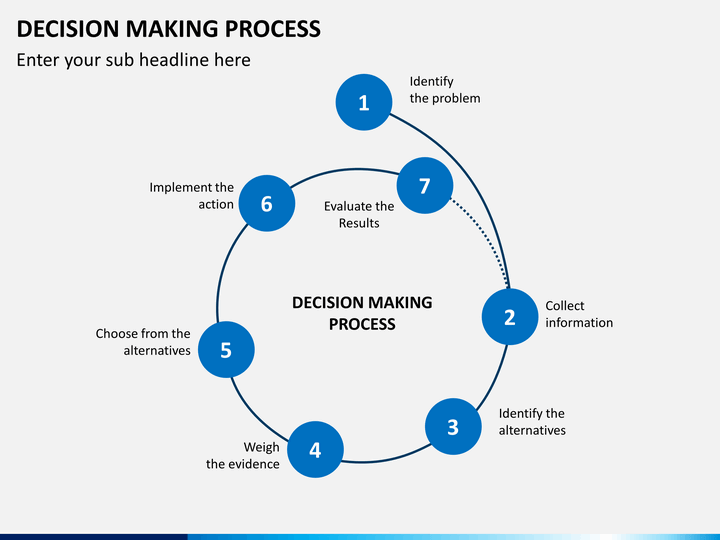
How an AI Decision-Making System Works
AI Decision-Making in Robotics
Robots require decision-making models to operate independently. A mobile robot, for example, may use cameras and distance sensors to understand its surroundings. An AI model can then determine whether the robot should continue along its current route, slow down, avoid an obstacle, or select another path.
Autonomous vehicles, industrial robots, service robots, agricultural robots, warehouse robots, and drones can all benefit from intelligent decision-making. The complexity of the model depends on the robot’s mission, available computing resources, safety requirements, and operating environment.
For related robotics learning topics, explore the Robotics Engineering Courses homepage.
Important Factors in AI Decision Models
- Accuracy: The system should produce reliable decisions from available data.
- Speed: Decisions may need to be produced in milliseconds for real-time robotics.
- Uncertainty: The model should handle incomplete or noisy information.
- Safety: High-risk decisions should include appropriate safety constraints.
- Adaptability: Intelligent systems should respond to changing environments.
- Explainability: Important decisions may need to be understandable to engineers and operators.
- Computational Efficiency: The model should match the processing capabilities of the robot.
Applications of AI-Based Decision-Making Models
| Application | Decision-Making Function |
|---|---|
| Autonomous Mobile Robots | Select routes, avoid obstacles, and respond to environmental changes. |
| Industrial Robotics | Optimize production actions, detect faults, and adjust processes. |
| Warehouse Robots | Choose efficient paths, prioritize tasks, and coordinate movement. |
| Agricultural Robots | Determine where to inspect, water, spray, harvest, or perform other tasks. |
| Medical Robotics | Assist with navigation, image interpretation, monitoring, and controlled procedures. |
| Service Robots | Understand user requirements and select appropriate actions. |
| Drones | Plan movement, avoid hazards, and respond to changing flight conditions. |
Advantages
- Supports autonomous operation with less human intervention.
- Can process large amounts of information quickly.
- Can identify patterns that may be difficult to recognize manually.
- Can adapt decisions using newly available information.
- Can optimize decisions according to multiple objectives.
- Can improve operational efficiency and resource utilization.
- Can support real-time responses in dynamic environments.
Challenges and Limitations
Despite their capabilities, AI decision-making systems have important limitations. Poor-quality training data can result in poor decisions. Sensor errors can cause an AI model to misunderstand the environment. A model trained in one environment may also perform poorly when deployed in another environment with substantially different conditions.
Another challenge is explainability. Some complex AI models may provide an accurate decision without making the reasoning process easy for engineers or users to understand. For safety-critical robots, designers may therefore combine AI with explicit rules, constraints, monitoring systems, and emergency controls.
AI Decision-Making and Path Planning
Decision-making is closely connected with robotic path planning. A robot may have several possible routes between two locations. An AI-based decision model can evaluate distance, obstacles, energy consumption, traffic, risk, and expected travel time before selecting a route.
This makes AI particularly valuable in dynamic environments where the best route can change continuously. Decision models can work together with perception, localization, mapping, and motion-control systems to create a complete autonomous robotic architecture.
Future of AI-Based Decision-Making
Future robotic systems are expected to combine multiple AI techniques rather than depend on a single decision model. A robot may use neural networks for perception, probabilistic reasoning for uncertainty, optimization for resource allocation, and reinforcement learning for improving its behavior through experience.
As robots become more capable of working alongside humans, decision-making models will also need to consider human intentions, safety, collaboration, communication, and ethical constraints. The objective is not simply to make robots autonomous, but to make their decisions reliable, efficient, safe, and appropriate for the environment in which they operate.
Conclusion
AI-Based Decision-Making Models provide the intelligence required for robots and autonomous systems to select appropriate actions in complex environments. Rule-based systems, decision trees, probabilistic models, fuzzy logic, neural networks, reinforcement learning, and optimization methods each provide different capabilities.
Effective robotic decision-making depends on combining accurate perception, reliable data, intelligent reasoning, safety constraints, and efficient action execution. As AI and robotics continue to develop, these models will become increasingly important in industrial automation, autonomous vehicles, smart manufacturing, healthcare robotics, agriculture, logistics, and human-robot collaboration.