Probabilistic Planning Methods
Understanding how robots make reliable decisions when the environment, sensors, actions, and future outcomes involve uncertainty.
What Are Probabilistic Planning Methods?
Probabilistic planning methods are techniques used in robotics to generate actions when the robot cannot predict the future with complete certainty. Real-world robots operate with uncertain sensor measurements, imperfect motion, changing environments, and actions that may not always produce the expected result.
Instead of assuming that every action has a guaranteed outcome, probabilistic planning represents possible states and outcomes using probabilities. The planner evaluates alternative actions and selects a sequence that provides a desirable balance between objectives such as safety, travel time, energy consumption, and task success.
Why Uncertainty Matters in Robot Planning
A conventional deterministic planner may assume that a robot knows its exact position and that its motion commands are executed perfectly. These assumptions rarely hold in practical robotics. A wheel may slip, a sensor may produce noise, or an obstacle may unexpectedly move.
Probabilistic planning allows these uncertainties to be incorporated into the planning process. The robot can estimate the likelihood of different outcomes and select actions that are more robust to uncertainty.
Major Probabilistic Planning Methods
Markov Decision Processes
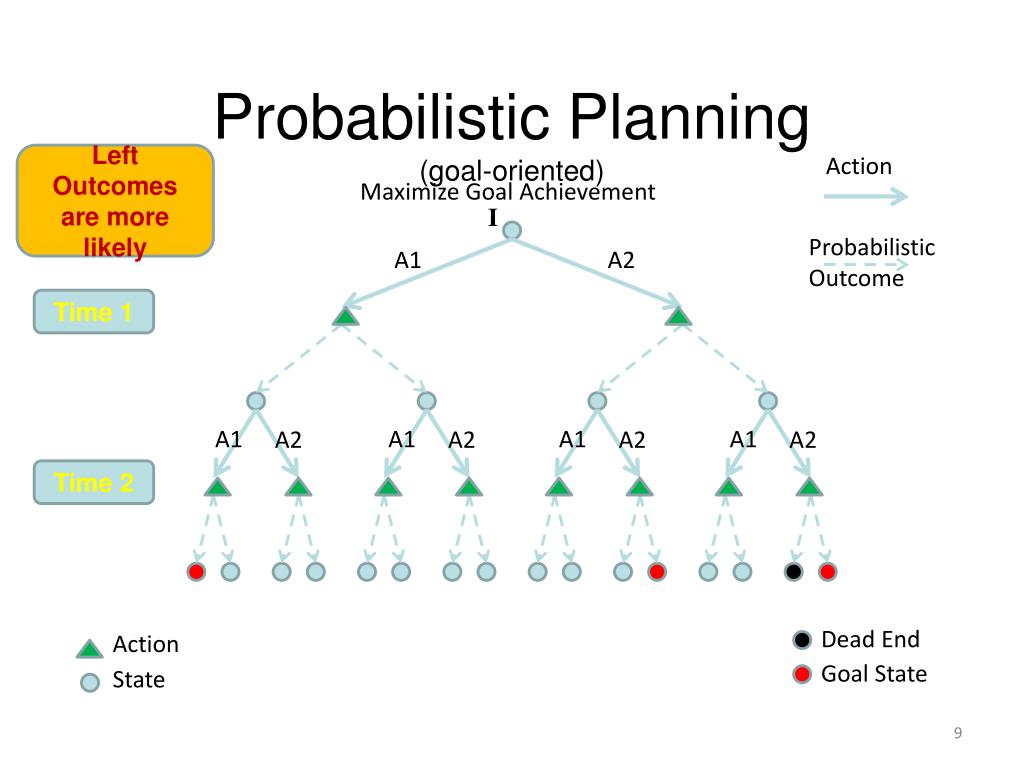
Markov Decision Processes (MDPs) represent a planning problem using states, actions, transition probabilities, and rewards. They are useful when a robot must repeatedly make decisions under uncertainty.
Partially Observable MDPs
POMDPs extend MDPs by considering situations where the robot cannot directly observe its true state. The robot maintains a belief about possible states and updates that belief as new sensor information becomes available.
Probabilistic Roadmaps
Probabilistic Roadmaps (PRM) use randomly generated samples in the robot’s configuration space. Collision-free samples are connected to form a roadmap that can be searched for feasible paths.
Rapidly-Exploring Random Trees
RRT-based methods randomly explore the configuration space and progressively build a tree. They are particularly useful for motion planning in high-dimensional spaces.
Monte Carlo Planning
Monte Carlo techniques evaluate possible future outcomes by sampling many scenarios. They can be useful when the planning problem has a large or complicated decision space.
Belief-Space Planning
Belief-space planning considers uncertainty in the robot’s estimated state. Instead of planning only for position, the planner considers how certain or uncertain that position is.
Markov Decision Process Model
An MDP provides a mathematical framework for sequential decision making. A typical MDP contains a set of states, available actions, transition probabilities, and a reward function.
The expression above represents the probability that the robot transitions from state s to state s’ after taking action a.
A reward function can be used to express the value of reaching a particular state or performing a particular action. The planner then attempts to identify a policy that maximizes expected long-term reward.
Belief-State Planning
In many robotics applications, the robot does not know its exact position or the complete state of its environment. Instead, it maintains a probability distribution called a belief state.
For example, a mobile robot may estimate that there is a 70 percent probability that it is in one corridor and a 30 percent probability that it is in another. Sensor observations can then update these probabilities.
This approach is particularly important for autonomous robots operating in environments where GPS is unavailable, sensors are noisy, or the surroundings are only partially observable.
Probabilistic Motion Planning
Probabilistic motion planning is concerned with finding safe and efficient robot trajectories when the robot’s configuration, movement, or environment may contain uncertainty.
Sampling-based planners such as PRM and RRT are widely used because they can handle complex configuration spaces without explicitly constructing the entire space. Random samples are generated and tested for feasibility, allowing the planner to explore promising regions.
- Mobile robot navigation
- Manipulator motion planning
- Autonomous vehicle trajectory generation
- Drone navigation
- Multi-robot coordination
- Industrial robotic systems
Typical Probabilistic Planning Process
- Define the states: Identify the robot’s relevant positions, configurations, environmental conditions, or task states.
- Identify uncertainty: Determine which sensor, motion, environmental, or task variables are uncertain.
- Build the probabilistic model: Represent possible transitions and observations using probability distributions.
- Generate candidate actions: Identify actions or trajectories available to the robot.
- Evaluate outcomes: Estimate the probability, cost, risk, and reward associated with possible outcomes.
- Select a policy or path: Choose the action sequence that provides the desired expected performance.
- Update using new observations: As the robot moves, new sensor data is used to update its state estimate and planning decisions.
Advantages of Probabilistic Planning
- Handles uncertain sensor information.
- Can account for imperfect robot motion.
- Supports decision making in partially observable environments.
- Provides a framework for balancing risk and reward.
- Can improve the robustness of autonomous navigation.
- Supports planning for dynamic and unpredictable environments.
- Can combine information from multiple uncertain sources.
Challenges
Probabilistic planning can require substantial computational resources. The number of possible states and actions may grow rapidly as the complexity of the robotic system increases. Maintaining probability distributions and evaluating many possible future scenarios can also become computationally expensive.
Another challenge is constructing an accurate probabilistic model. If transition probabilities or sensor models do not represent the real environment adequately, the resulting plan may not perform as expected.
Applications in Robotics
Probabilistic planning methods are important in autonomous systems where decisions must be made despite uncertainty. Autonomous mobile robots can use them to select safer navigation routes, while drones can use probabilistic models to handle uncertain positioning and environmental conditions.
In industrial robotics, probabilistic planning can help robots manipulate objects when their exact positions are uncertain. In service robotics, these methods can support navigation and task planning around humans and changing environments.
Probabilistic Planning and Artificial Intelligence
Probabilistic planning forms an important connection between robotics, artificial intelligence, machine learning, and decision theory. Modern autonomous robots can combine probabilistic models with learning algorithms to improve their understanding of uncertain environments.
This combination enables robots to move beyond fixed instructions toward adaptive decision making. The robot can observe its surroundings, estimate uncertainty, evaluate alternatives, and continuously revise its plan.
Explore Robotics Engineering
Learn more about robotics engineering, autonomous systems, robot planning, programming, simulation, and related technical subjects through the main robotics learning resource:
Definition
Probabilistic planning methods are decision-making and planning approaches that explicitly account for uncertainty in the environment, system dynamics, and sensing. Instead of assuming that actions lead to deterministic outcomes, probabilistic planning models the world using probability distributions and selects actions that maximize expected utility or success. These methods are essential in real-world situations where outcomes are uncertain due to noise, incomplete information, or unpredictable changes. Probabilistic planning provides a principled framework for making robust and risk-aware decisions in complex environments.
Engineering Perspective
From an engineering standpoint, probabilistic planning is built on probability theory, stochastic processes, and optimization. The environment is typically modeled using structures such as Markov Decision Processes (MDPs) or Partially Observable Markov Decision Processes (POMDPs). In these models, state transitions and observations are represented probabilistically, capturing the likelihood of different outcomes.
Engineers design planning algorithms that operate over belief states—probability distributions over possible system states. Common techniques include value iteration, policy iteration, and belief-space planning. For large or continuous state spaces, approximate methods such as Monte Carlo sampling, particle-based representations, and heuristic search are used.
In robotics, probabilistic planning is often integrated with localization and SLAM systems, where uncertainty in pose estimation directly influences planning decisions. Risk-sensitive cost functions and chance constraints are engineered to ensure safety. Computational efficiency is a key challenge, so hierarchical and receding-horizon planning methods are frequently applied to enable real-time operation.
Real-Life Example
A real-life example of probabilistic planning methods is an autonomous warehouse robot tasked with transporting goods. The robot operates in a dynamic environment where human workers and other robots move unpredictably. Sensor measurements of obstacles and robot position are noisy, and planned paths may become blocked.
Using probabilistic planning, the robot maintains a belief about its own position and the likely locations of obstacles. It evaluates multiple possible action sequences, estimating the probability of success and expected travel time for each. The robot then chooses a plan that balances efficiency and safety, such as taking a slightly longer route with a lower collision risk. This approach allows reliable operation even under uncertainty.
Applications
Probabilistic planning methods are widely used across robotics and intelligent systems. In autonomous vehicles, they enable safe navigation by accounting for uncertain behaviour of other road users. In aerial and underwater robotics, probabilistic planning helps manage uncertain environmental forces like wind or currents.
In healthcare, treatment planning and medical decision support use probabilistic models to account for uncertainty in diagnosis and patient response. In finance, probabilistic planning supports investment strategies that balance risk and return under market uncertainty.
In space exploration, rovers and spacecraft rely on probabilistic planning to operate autonomously in unknown and hazardous environments. Overall, probabilistic planning methods are fundamental to building intelligent systems that can reason, plan, and act effectively in the face of uncertainty.