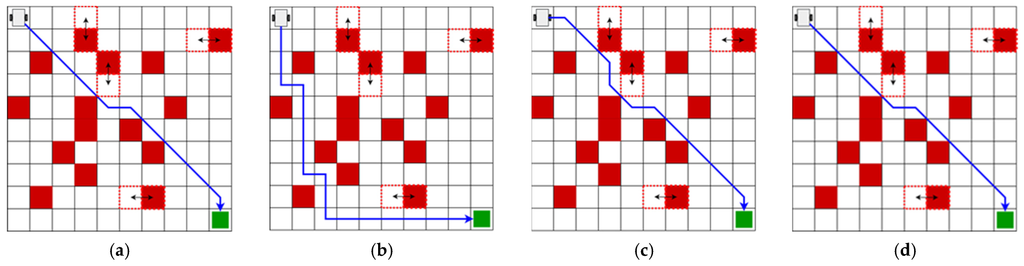
Learning-Based Path Planning
How machine learning helps robots discover efficient and intelligent paths.
Learning-Based Path Planning is an advanced approach to robot navigation in which a robot uses data, machine learning algorithms, or reinforcement learning to learn how to select effective paths through an environment. Instead of relying entirely on manually designed rules, the robot can improve its navigation decisions by learning from examples or previous experiences.
What Is Learning-Based Path Planning?
Path planning is the process of determining a suitable route for a robot to travel from a starting position to a target position. Traditional methods generally use mathematical models, maps, search algorithms, and predefined rules. Learning-based path planning adds an intelligent learning component that allows the robot to make navigation decisions based on acquired data and experience.
A learning-based planner may learn relationships between the robot’s current state, surrounding environment, obstacles, destination, and the desired movement. This can be particularly useful in complex environments where manually programmed navigation rules may not handle every possible situation.
Why Is Learning Important in Robot Path Planning?
Real-world environments are often unpredictable. People can move around, objects can change position, sensors can contain noise, and a robot may encounter situations that were not included in its original programming. Learning-based techniques can help robots adapt their navigation behavior to such changing conditions.
How Learning-Based Path Planning Works
Machine Learning for Path Planning
Machine learning can be used to identify patterns in navigation data. For example, a model can be trained using examples of robot movements in different environments. The model can then estimate which movement or route is likely to produce a desirable result.
Supervised learning, unsupervised learning, and reinforcement learning can all contribute to robot navigation research. The appropriate technique depends on the available data, environment, robot capabilities, and navigation objectives.
Reinforcement Learning and Path Planning
Reinforcement learning is particularly interesting for autonomous navigation. In this approach, an agent interacts with an environment and receives rewards or penalties according to its actions. Over repeated interactions, the agent can learn a policy that favors actions producing better results.
For path planning, rewards may consider reaching the destination, avoiding obstacles, reducing travel distance, maintaining smooth motion, and minimizing unnecessary energy consumption.
Learning-Based Obstacle Avoidance
Obstacle avoidance is an important part of autonomous robot navigation. A learning-based system can use sensor information to recognize obstacles and determine appropriate movements. This is especially valuable when obstacles are dynamic, such as people, vehicles, or other robots.
A robot operating in a warehouse, for example, may need to navigate around shelves, workers, moving carts, and other autonomous machines. Learning techniques can help the robot develop navigation policies that respond to changing conditions.
Advantages of Learning-Based Path Planning
- Can adapt to complex and changing environments.
- Can learn navigation behavior from large amounts of data.
- Can improve performance through experience.
- Can support autonomous decision-making.
- Can be combined with conventional path-planning algorithms.
- Can be trained extensively in simulation before real-world deployment.
- Can potentially optimize multiple navigation objectives simultaneously.
Challenges
Despite its advantages, learning-based path planning introduces several engineering challenges. A learning model may require significant training data and computational resources. The model must also behave safely when it encounters situations that differ from its training environment.
Another challenge is reliability. A navigation system used in a real robot must consider safety, predictable behavior, sensor failures, and unexpected obstacles. For this reason, learning-based planning is often combined with conventional safety mechanisms and motion-planning techniques.
Learning-Based Planning in Simulation
Simulation provides an effective environment for developing and testing learning-based navigation systems. Thousands or millions of navigation scenarios can potentially be generated without putting a physical robot at risk.
Engineers can vary obstacle positions, target locations, robot dynamics, sensor conditions, and environmental layouts during training. A trained model can subsequently be evaluated in increasingly realistic environments.
Applications
Learning-based path planning has applications across many areas of robotics. These include autonomous mobile robots, warehouse robots, delivery robots, agricultural robots, service robots, search-and-rescue systems, autonomous vehicles, and intelligent drones.
In industrial environments, learning-based navigation can help robots move efficiently between workstations. In service robotics, it can support navigation through environments where humans and robots share the same space.
Combining Learning with Traditional Algorithms
Learning-based planning does not necessarily have to replace conventional path-planning methods. A powerful engineering strategy is to combine both approaches. A learning model may generate a high-level navigation decision, while a conventional planner or controller ensures that the resulting motion remains feasible and safe.
This hybrid approach can provide the adaptability of machine learning while retaining important engineering constraints. It is particularly useful when safety and predictable robot behavior are important.
Future of Learning-Based Path Planning
The future of robot navigation is likely to involve increasingly capable learning systems combined with improved sensors, simulation environments, optimization techniques, and traditional robotics algorithms. Robots may become better at understanding unfamiliar environments and selecting paths based on experience.
As robotics engineering continues to develop, learning-based path planning will remain an important area for researchers, students, and engineers interested in autonomous systems and intelligent machines.
Learn More About Robotics Engineering
Learning-based path planning connects several important areas of robotics, including autonomous navigation, machine learning, robot programming, perception, control, and simulation. For additional robotics engineering learning resources and related topics, visit the Robotics Engineering Courses website.