How Hierarchical Decision Making Works in Robots: Hardware, Software, and Implementation
Hierarchical Decision Making is an important approach used to make robots more intelligent, organized, and capable of performing complex tasks. Instead of asking a robot to make every decision at the same level, hierarchical decision making divides the robot’s thinking process into different layers. Higher levels decide what the robot should achieve, while lower levels determine how to achieve it. This structure allows robots to handle complicated environments, respond to unexpected situations, and complete tasks efficiently.
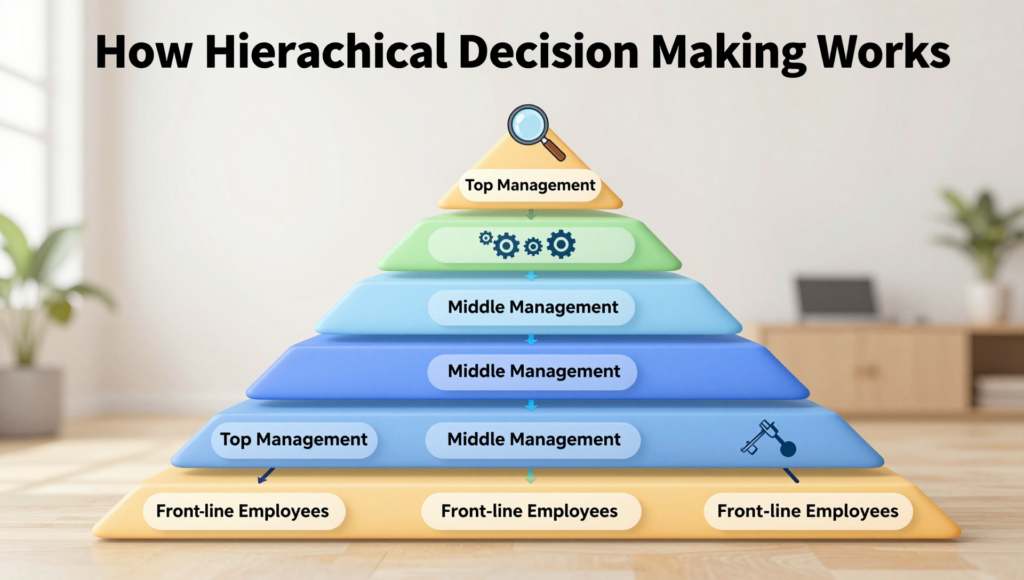
For example, imagine a delivery robot that must carry a package from one building to another. At the highest level, the robot decides its main goal: deliver the package. At the next level, it chooses a strategy: travel to the destination using a particular route. At a lower level, it decides which streets or corridors to follow. Finally, the lowest level controls the motors, wheels, and brakes to physically move the robot. This is hierarchical decision making in action.
The Basic Structure of Hierarchical Decision Making
A typical hierarchical robot decision-making system can be divided into three or more layers.
The high-level layer is responsible for strategic decisions. It understands the overall objective and determines what needs to be accomplished. For example, a household robot may receive the instruction, “Clean the living room.” The high-level system converts this broad objective into smaller goals such as finding the living room, identifying objects on the floor, avoiding obstacles, and cleaning the area.
The middle-level layer handles planning and task management. It determines the sequence of actions required to achieve the high-level objective. For the cleaning robot, this could mean navigating to the living room, selecting a cleaning pattern, moving around furniture, and returning to its charging station.
The low-level layer controls immediate physical actions. It sends commands to motors and actuators. It may decide how fast a wheel should rotate, how much a robotic arm should move, or how strongly a gripper should hold an object.
This layered structure creates a chain:
Goal → Plan → Action → Motor Control
Each level communicates with the level below it and receives information from the level above it.
How a Robot Uses Hierarchical Decision Making
To understand the process, consider an autonomous mobile robot operating inside a warehouse.
First, the robot receives a high-level command: “Move the package to Station B.”
The high-level decision system identifies the goal and checks the robot’s available resources. It may determine that the robot needs to pick up the package and transport it to Station B.
The middle-level planner then creates a sequence:
- Navigate to the package.
- Position the robot correctly.
- Pick up the package.
- Navigate to Station B.
- Place the package at the destination.
The low-level controller then executes each step. Sensors continuously provide information about the environment. If an obstacle suddenly appears, the robot does not necessarily need to reconsider its entire mission. The high-level goal remains unchanged—deliver the package—but the lower-level system can modify the immediate movement.
This is one of the major advantages of hierarchical decision making. The robot can change its actions without losing sight of its main objective.
Hardware Required
A hierarchical decision-making robot needs several types of hardware.
1. Processing Unit
The robot requires a computer to run its decision-making algorithms. This could be a single-board computer such as a Raspberry Pi, an NVIDIA Jetson device, or a more powerful industrial computer. More advanced robots may use multiple computers, with one processor handling high-level artificial intelligence and another handling real-time motor control.
2. Sensors
Sensors allow the robot to understand the world. Common sensors include:
- Cameras for visual perception
- LiDAR for measuring distance and mapping environments
- Ultrasonic sensors for obstacle detection
- Infrared sensors for proximity detection
- IMU sensors for orientation and acceleration
- GPS for outdoor positioning
- Force and torque sensors for robotic arms
- Encoders for measuring wheel or joint movement
The robot uses sensor data to determine whether its decisions are working correctly.
3. Actuators and Motors
Actuators allow the robot to physically interact with the environment. These include DC motors, servo motors, stepper motors, hydraulic systems, and electric linear actuators.
For example, a mobile robot may use four electric motors for movement, while a robotic arm may use several servo motors to control its joints.
4. Motor Controllers
A processor cannot normally drive powerful motors directly. Motor drivers or motor controllers receive commands from the computer and regulate the power supplied to the motors.
5. Communication Hardware
Robots may use Wi-Fi, Bluetooth, Ethernet, 5G, or other communication systems to exchange information with external computers or cloud services.
Software Required
The software architecture is just as important as the hardware.
The robot typically runs an operating system such as Linux, along with a robotics framework such as ROS 2 (Robot Operating System 2). ROS 2 provides tools and communication systems that allow different robot components to exchange information.
The software can be divided into several modules.
Perception software processes sensor data. Computer vision algorithms analyze camera images, while LiDAR-processing algorithms help create maps and detect obstacles.
Localization software determines where the robot is located. Techniques such as SLAM—Simultaneous Localization and Mapping—allow a robot to build a map while estimating its own position.
Planning software determines how the robot should achieve its objectives. High-level planners may use task planning, behavior trees, finite-state machines, or artificial intelligence models.
Navigation software determines the route from one location to another.
Control software converts planned actions into precise motor commands. Algorithms such as PID control help maintain accurate speed, position, and movement.
How to Build Such a Robot
A practical development process begins with a clear objective. First, define exactly what the robot must accomplish. Next, select the appropriate sensors, motors, processor, and communication systems.
Then develop the software in layers. Begin with low-level motor control. After that, add sensor processing and localization. Next, develop navigation and task planning. Finally, introduce the high-level decision-making system.
For example:
High Level: “Deliver the package.”
Task Planner: “Pick up → Navigate → Deliver.”
Navigation Layer: “Follow Route A.”
Motion Controller: “Turn left 30 degrees and move forward.”
Motor Layer: “Set left and right wheel speeds.”
Feedback from the sensors continuously travels upward through the hierarchy. If the robot detects a blocked path, the navigation layer can select a new route. If the package is missing, the task planner can reconsider the current task. If the entire mission becomes impossible, the high-level system can select a new strategy.
Conclusion
Hierarchical Decision Making provides robots with a structured way to think and act. It separates long-term goals from short-term actions, making complex robotic systems easier to design, control, and improve. The hardware provides the robot with sensing, computing, movement, and communication, while the software provides perception, planning, navigation, decision making, and control.
The most powerful robotic systems combine these layers with artificial intelligence and machine learning. As robots become more autonomous, hierarchical decision making will become increasingly important because it allows a robot to operate at different levels of intelligence—from understanding a broad mission to controlling a single motor—while continuously adapting to changes in the real world.