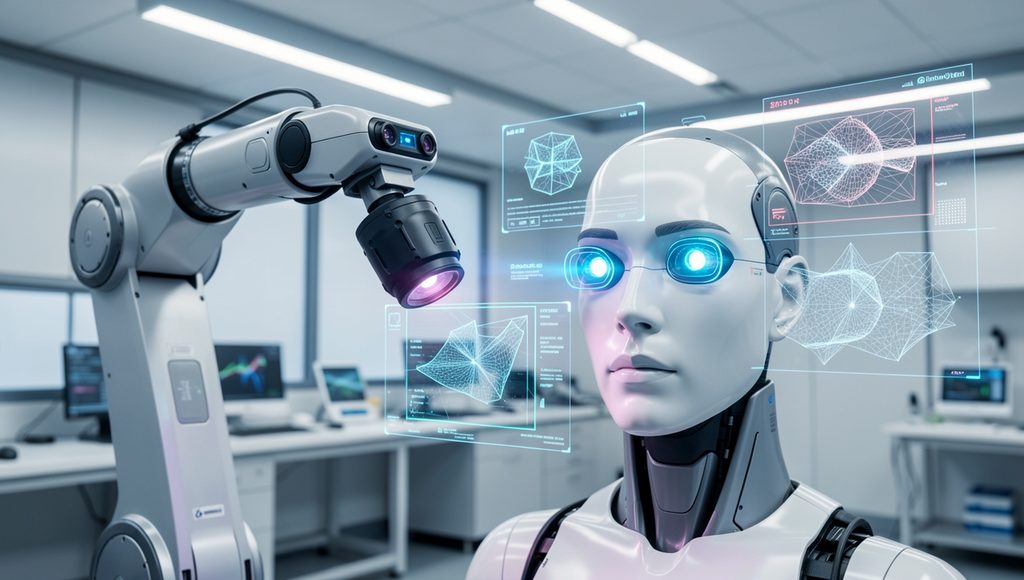
Image Processing for Robots
Image processing enables robots to analyze visual information captured by cameras and convert images into useful information for perception, navigation, object recognition, inspection, and intelligent decision-making.
Why Image Processing Is Important for Robots
Robots operate in environments that may contain people, objects, obstacles, pathways, machines, and changing lighting conditions. A camera provides visual information, but raw camera images are often not immediately suitable for robotic decision-making.
Image processing transforms raw visual data into information that a robot can use. For example, a mobile robot can process camera images to identify an obstacle, detect a pathway, recognize an object, or estimate where an object is located.
How Image Processing Works in Robots
A typical robotic vision system follows several stages. The exact process depends on the robot, camera, environment, and application.
Image Capture
A camera mounted on the robot captures images or video of the surrounding environment.
Preprocessing
The captured image may be resized, filtered, enhanced, or adjusted to reduce unwanted noise.
Feature Extraction
Important visual features such as edges, shapes, colors, textures, or patterns can be identified.
Object Detection
The system identifies relevant objects or regions in an image according to the robot’s task.
Scene Analysis
Visual information is interpreted to understand the environment and relationships between objects.
Robot Action
The processed information can support navigation, manipulation, inspection, or other robot actions.
Common Image Processing Techniques
Robots can use different image processing techniques depending on the type of visual information that needs to be extracted.
1. Image Filtering
Filtering can reduce image noise and improve image quality. Smoothing filters may be useful when a camera produces noisy measurements.
2. Edge Detection
Edge detection identifies significant changes in image intensity. Robots can use edges to recognize boundaries, shapes, objects, and structural features.
3. Thresholding
Thresholding separates image regions according to pixel intensity or other visual characteristics. It can simplify an image before further analysis.
4. Image Segmentation
Segmentation divides an image into meaningful regions. A robot may use segmentation to separate an object from its background or distinguish different areas of a scene.
5. Color Analysis
Color information can help robots identify objects, markers, surfaces, products, or navigation indicators.
6. Object Recognition
Object recognition allows a robot to determine what objects are present in an image. This capability is particularly useful in industrial automation, service robots, and robotic manipulation.
Image Processing and Robot Vision
Image processing is an important part of robotic vision. A camera collects visual information, while image processing techniques help prepare and analyze that information.
Modern robotic systems can combine traditional image processing with computer vision and machine learning. This allows robots to move beyond simple image enhancement toward more sophisticated perception tasks.
Applications of Image Processing in Robotics
| Application | How Image Processing Helps |
|---|---|
| Object Detection | Identifies objects that are relevant to the robot’s task. |
| Navigation | Helps the robot understand pathways, obstacles, and visual landmarks. |
| Industrial Inspection | Helps identify defects, irregularities, and product characteristics. |
| Robot Manipulation | Provides visual information about the location and appearance of objects. |
| Autonomous Vehicles | Supports visual perception of roads, obstacles, signs, and other objects. |
| Service Robots | Helps robots recognize objects and understand aspects of indoor environments. |
Image Processing for Robot Navigation
Mobile robots often need to determine where they are and what is around them. Camera images can provide useful information for identifying obstacles, corridors, doors, landmarks, and other environmental features.
Image processing can therefore contribute to navigation systems by extracting visual features that help the robot estimate movement and understand its surroundings.
Image Processing for Object Detection
Object detection is one of the most useful applications of visual processing in robotics. A robot may need to identify a particular object before picking it up, inspecting it, moving it, or interacting with it.
The processing system can analyze the camera image and identify regions that potentially correspond to the desired object. Additional vision algorithms can then estimate the object’s position and characteristics.
Image Processing in Industrial Robots
Industrial robots can use cameras and image processing systems for inspection, sorting, assembly, quality control, and material handling.
For example, a vision-enabled robot may inspect products on a production line and determine whether their appearance matches the expected characteristics. Image processing can help identify missing components, incorrect positioning, surface irregularities, or other visible differences.
Challenges in Robotic Image Processing
- Changing lighting conditions can affect image quality.
- Motion can cause blurred images.
- Objects may be partially hidden or occluded.
- Complex backgrounds can make object detection difficult.
- Real-time processing requires efficient algorithms and computing resources.
- Camera position and calibration can influence measurement accuracy.
Image Processing and Artificial Intelligence
Traditional image processing methods can be combined with artificial intelligence to create more capable robotic vision systems. Machine learning and deep learning methods can help robots recognize complex objects and visual patterns.
In an intelligent robot, the overall process may involve camera capture, image preprocessing, visual recognition, environment interpretation, decision-making, and physical action.
Benefits of Image Processing for Robots
- Improves robotic perception.
- Supports automated object recognition.
- Helps robots operate in changing environments.
- Supports visual inspection and quality control.
- Provides useful information for autonomous navigation.
- Can improve robot interaction with objects and people.
- Enables more flexible automation systems.
Future of Image Processing in Robotics
As robotic systems become more autonomous, their ability to understand visual information becomes increasingly important. Improvements in cameras, processors, artificial intelligence, and computer vision are helping robots analyze increasingly complex environments.
Future robotic vision systems are expected to combine multiple visual inputs with other sensors so that robots can make more reliable decisions. Image processing will remain an important foundation for these perception systems.
Explore More Robotics Topics
Conclusion
Image processing is a fundamental technology for robots that need to understand visual information. By processing camera images, robots can detect objects, analyze environments, recognize patterns, support navigation, and perform inspection and manipulation tasks.
When image processing is combined with computer vision, sensors, machine learning, and robotic control, it can help create more capable and autonomous robotic systems.