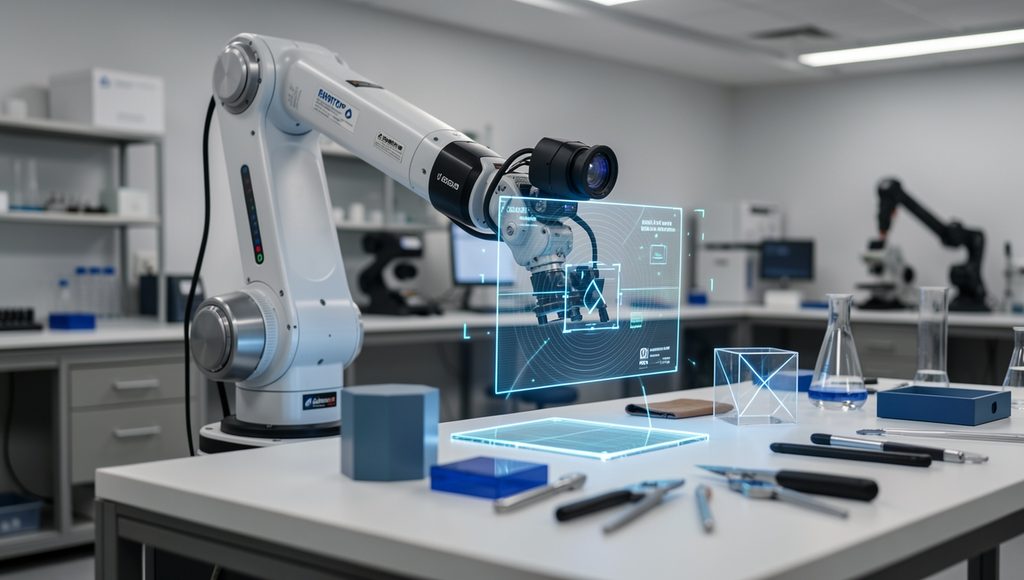
Object Detection in Robots
Learn how robots identify, locate, and understand objects using cameras, sensors, image processing, and artificial intelligence.
What Is Object Detection in Robots?
Object detection is an important capability that allows a robot to identify objects in its surrounding environment and determine where those objects are located.
A robot can use object detection to recognize objects such as people, boxes, tools, vehicles, furniture, packages, and obstacles.
Object detection combines sensors, cameras, image processing, machine learning, and artificial intelligence to provide robots with useful information about their surroundings.
Learn more robotics topics at Robotics Engineering Courses .
Why Is Object Detection Important?
Navigation
Robots can detect objects and obstacles and use this information to select safer paths.
Object Manipulation
Robotic arms can identify objects that need to be picked, moved, sorted, or assembled.
Robot Safety
Detecting people, vehicles, and obstacles can help robots reduce the possibility of collisions.
Automation
Robots can automatically inspect, classify, count, and handle objects in different environments.
How Object Detection Works in Robots
Object detection usually follows a sequence of sensing, processing, recognition, and action.
Sense the Environment
The robot collects information using cameras, depth sensors, LiDAR, ultrasonic sensors, or other sensing devices.
Capture Data
Cameras and sensors collect images, video frames, depth information, or distance measurements.
Process the Data
The robot processes the sensor information and prepares it for object detection algorithms.
Detect Objects
A detection system identifies objects and may locate them using bounding boxes or spatial data.
Classify Objects
The system determines the category of each detected object, such as a person, box, vehicle, or tool.
Take Action
The robot uses the detection result to navigate, pick an object, avoid an obstacle, or perform another task.
Sensors Used for Object Detection
| Sensor | Purpose | Robotic Application |
|---|---|---|
| RGB Camera | Captures color images | Object recognition and classification |
| Depth Camera | Provides distance information | 3D object detection and manipulation |
| LiDAR | Measures distances | Mapping and obstacle detection |
| Ultrasonic Sensor | Measures nearby objects | Short-range obstacle detection |
| Thermal Camera | Detects heat patterns | Inspection and specialized detection |
Image Processing for Object Detection
Before detecting objects, a robot may process images to improve their quality and extract useful information. Image processing can include resizing, noise reduction, contrast adjustment, edge detection, segmentation, and feature extraction.
Modern robotic systems can also use artificial intelligence models to analyze images and detect multiple objects within the same scene.
Object Detection vs. Image Classification
Image classification determines what an image represents. Object detection goes further by identifying individual objects and determining their locations within an image.
Common Object Detection Approaches
Traditional Methods
These methods can use color, shape, edges, contours, and manually designed visual features.
Machine Learning
Machine learning algorithms can learn patterns from training data to recognize different objects.
Deep Learning
Deep neural networks can learn complex visual features and identify multiple object categories.
3D Object Detection
3D detection combines visual and depth information to estimate the position of objects in space.
Applications of Object Detection in Robots
- Warehouse robots: Detect packages, shelves, pallets, and workers.
- Industrial robots: Locate components for assembly and inspection.
- Service robots: Recognize people, furniture, doors, and household objects.
- Agricultural robots: Detect crops, fruits, weeds, and obstacles.
- Autonomous vehicles: Detect vehicles, pedestrians, road objects, and obstacles.
- Medical robots: Support visual inspection and object localization.
- Educational robots: Demonstrate robotics, computer vision, and AI concepts.
Object Detection for Robotic Arms
Object detection is particularly useful for robotic arms. A camera can observe a workspace and identify the position of objects.
After identifying an object, the robot can use its position and other information to plan an appropriate movement.
For example, in an automated sorting system, a camera can detect different objects moving along a conveyor. The robotic arm can then select and move each object to its designated location.
Challenges in Robotic Object Detection
Changing Lighting
Shadows, reflections, darkness, and changing illumination can make objects harder to detect.
Object Occlusion
One object may partially or completely block another object from the robot’s sensors.
Complex Backgrounds
Objects can be difficult to detect when their appearance is similar to the surrounding environment.
Processing Speed
Robots often need detection results quickly to respond to moving objects and changing environments.
Unknown Objects
A robot may encounter objects that were not included in its training data.
Sensor Limitations
Sensors have limitations related to range, resolution, noise, and environmental conditions.
Object Detection and Robot Decision-Making
Object detection becomes more useful when it is connected to a robot’s decision-making system.
- Detect an object.
- Estimate its location.
- Determine whether the object is relevant.
- Plan an appropriate movement or response.
- Execute the action.
- Use sensor information to verify the result.
This creates a continuous perception-and-action cycle that allows robots to respond to changing environments.
Future of Object Detection in Robotics
Object detection will continue to play an important role as robots become more capable and autonomous.
Improvements in artificial intelligence, cameras, depth sensors, 3D perception, and edge computing can help robots recognize objects more quickly and reliably.
Future robots will increasingly combine object detection with scene understanding, object tracking, spatial reasoning, and autonomous decision-making.
Conclusion
Object detection gives robots the ability to identify and locate meaningful objects in their surroundings.
By combining cameras, sensors, image processing, machine learning, and artificial intelligence, robots can better understand their environment and respond appropriately.
Object detection is useful in warehouse automation, industrial robots, robotic arms, service robots, agriculture, autonomous vehicles, and many other applications.
Continue learning about robotics at Robotics Engineering Courses .