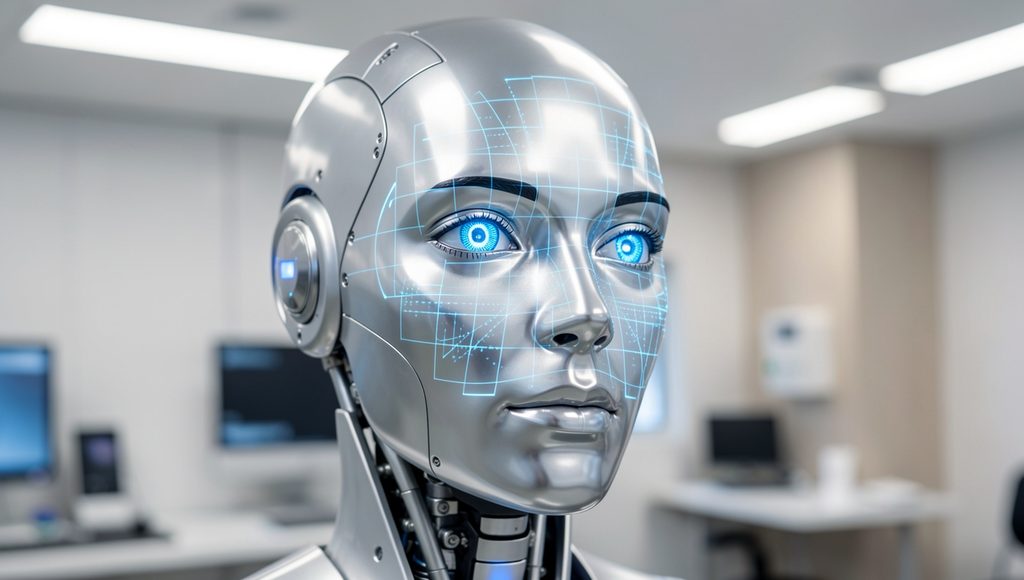
Face Recognition in Robots
Understanding how robots detect, analyze, and recognize human faces.
Face recognition in robots is a technology that enables robots to detect and identify people using cameras, computer vision, image processing, and artificial intelligence.
Instead of simply detecting that a person is present, a face recognition system can analyze facial characteristics and compare them with previously registered facial information. This capability can help robots provide personalized interactions and perform specific tasks.
What Is Face Recognition in Robots?
Face recognition is the process of identifying or verifying a person based on characteristics of their face. In robotics, a camera captures an image or video of a person. The robot then processes the visual information and searches for facial patterns.
When the system has access to authorized facial information, it can compare the detected face with stored representations and determine whether there is a match.
How Face Recognition Works in Robots
A robotic face recognition system normally follows several processing stages. These stages allow the robot to convert camera images into useful information for decision-making.
Components Used in Robotic Face Recognition
Camera
Cameras provide the visual information required to detect and analyze human faces.
Processor
A processor performs image processing and runs the algorithms required for face detection and recognition.
Computer Vision Software
Computer vision software processes camera images and identifies facial patterns.
Recognition Model
A recognition model compares facial representations and estimates whether they correspond to a known individual.
Data Storage
Some systems store authorized facial representations so that recognized users can be distinguished.
Robot Controller
The controller uses recognition results to influence the robot’s actions, communication, or behavior.
Face Detection vs Face Recognition
| Feature | Face Detection | Face Recognition |
|---|---|---|
| Purpose | Finds faces in an image or video. | Identifies or verifies a person. |
| Result | Location of a detected face. | Identity or similarity result. |
| Example | A person is present in front of the robot. | The detected face matches a registered person. |
| Robotic use | Useful for tracking and interaction. | Useful for personalized interaction and verification. |
Facial Features Analyzed by Robots
Face recognition systems analyze patterns and characteristics associated with a person’s face. Modern systems can use machine-learning models to create numerical representations of facial appearance.
- Facial landmarks
- Shape and structure of the face
- Relative positions of facial points
- Overall facial appearance
- Patterns learned from training data
- Numerical facial representations used for comparison
Role of Artificial Intelligence
Artificial intelligence can significantly improve the ability of robots to analyze faces. Machine-learning models can learn patterns from many examples and use those patterns when processing new images.
AI-based systems can help robots handle variations in lighting, facial orientation, appearance, and other environmental conditions. However, the performance of a recognition system depends on its camera, algorithms, training data, processing hardware, and operating environment.
Applications of Face Recognition in Robots
1. Service Robots
Service robots can recognize returning users and provide more personalized assistance.
2. Security Robots
Face recognition can be used as one component of identity verification or monitoring systems in controlled environments.
3. Healthcare Robots
In suitable environments, robots can identify registered users and provide personalized assistance.
4. Educational Robots
Educational robots can recognize registered students and provide customized interactions.
5. Social Robots
Social robots can use face recognition to distinguish between different users during human-robot interaction.
6. Reception Robots
Reception robots can identify registered visitors and provide personalized greetings or assistance.
Benefits of Face Recognition in Robots
- Enables personalized human-robot interaction.
- Allows robots to distinguish between registered users.
- Can support identity verification.
- Can improve social interaction with robots.
- Can support customized robotic services.
- Can work together with other perception technologies.
Challenges of Face Recognition in Robots
Robots operate in changing environments, so reliable face recognition can be challenging.
- Lighting: Poor or changing lighting can reduce image quality.
- Viewing angle: A face may appear from different directions.
- Occlusion: Glasses, masks, hands, or other objects can hide parts of the face.
- Movement: Fast movement can result in blurred images.
- Camera quality: Low-resolution cameras can reduce recognition performance.
- Processing requirements: Advanced recognition models can require significant computing resources.
- Privacy: Facial information requires responsible collection, storage, and use.
- Recognition errors: Systems can produce incorrect matches or fail to recognize a person.
Privacy and Responsible Use
Face recognition involves biometric information, making privacy and security important considerations in robotic applications.
A robotic system should have a clear purpose for collecting facial information. Access to stored information should be appropriately restricted, and organizations should follow applicable privacy requirements and policies.
Face Recognition and Human-Robot Interaction
Face recognition can make interactions between people and robots more personalized. For example, a robot may recognize an authorized user and use previously configured preferences during an interaction.
Face recognition can also work together with speech recognition, gesture recognition, object detection, and other robotic perception capabilities. Combining these technologies can help robots understand their environment and interact more effectively with humans.
Future of Face Recognition in Robots
Future robots are likely to combine face recognition with increasingly capable artificial intelligence and other perception technologies.
Improvements in cameras, processors, machine-learning models, and edge computing may allow robots to process visual information more efficiently. At the same time, privacy, security, transparency, and responsible use will remain important parts of robotic face recognition systems.
Conclusion
Face recognition in robots allows machines to detect, analyze, and identify people using cameras, image processing, computer vision, and artificial intelligence.
This technology can support service robots, social robots, educational robots, healthcare robots, reception robots, and controlled security applications.
Successful implementation requires suitable cameras, reliable recognition algorithms, sufficient processing capability, and responsible management of facial information.
Explore more robotics learning resources at Robotics Engineering Courses .