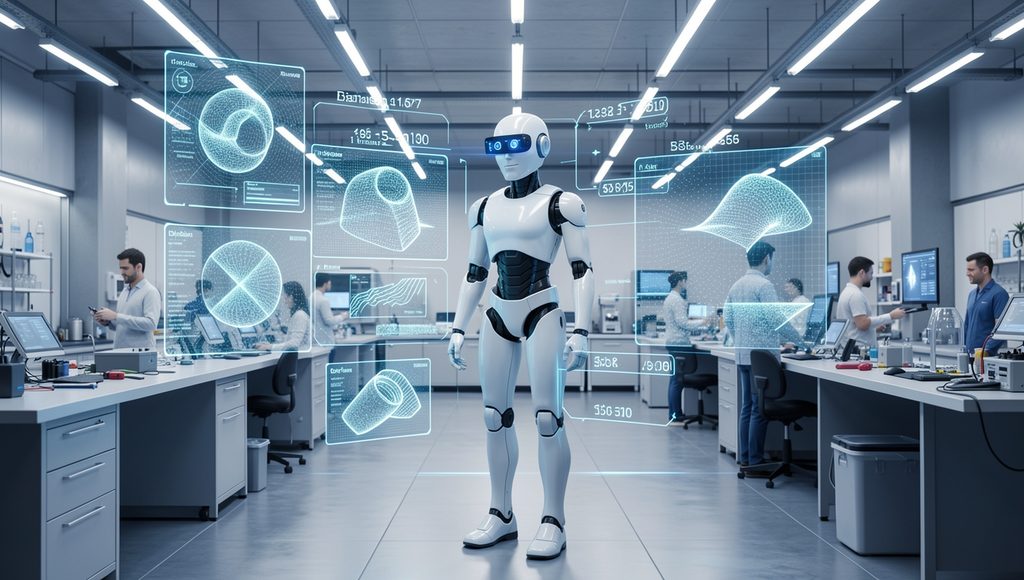
3D Vision for Robotics
Understanding depth, space, objects, and the environment through robotic vision.
What Is 3D Vision for Robotics?
3D vision is a technology that allows robots to understand the three-dimensional structure of their surroundings. Instead of seeing an environment only as a flat image, a robot equipped with 3D vision can estimate the distance, depth, position, and shape of objects.
This capability is important for autonomous robots, industrial robots, mobile robots, warehouse systems, inspection machines, robotic arms, and many other intelligent robotic applications.
Why 3D Vision Is Important
A conventional camera can provide information about color, brightness, patterns, and object appearance. However, a robot also needs to know where objects are located in three-dimensional space.
3D vision provides additional spatial information that helps robots make better decisions when navigating, picking objects, avoiding obstacles, and interacting with people or machines.
How 3D Vision Works
A typical robotic 3D vision system captures information about the environment and converts it into useful spatial data. The robot’s computer then processes this data to estimate object positions and distances.
- Capture: A camera or depth sensor collects visual information from the environment.
- Depth Measurement: The system determines how far different surfaces and objects are from the sensor.
- 3D Data Generation: Depth information can be represented as a depth map or point cloud.
- Object Analysis: Computer vision algorithms identify objects, surfaces, edges, and other features.
- Robot Decision: The robot uses the spatial information for navigation, manipulation, inspection, or another task.
3D Vision Technologies
Stereo Vision
Stereo vision uses two cameras positioned at different locations. By comparing the images from both cameras, the robot can estimate the depth of objects.
Depth Cameras
Depth cameras provide distance information for pixels in an image. This makes them useful for object detection, human tracking, navigation, and robotic manipulation.
LiDAR
LiDAR systems use laser measurements to determine the distance to surrounding surfaces. They are commonly used for mapping, navigation, and obstacle detection.
Structured Light
Structured-light systems project a known pattern onto an object or scene. Changes in the pattern help estimate the three-dimensional shape of the surface.
Point Clouds in Robotics
A point cloud is a collection of points representing the three-dimensional structure of an environment or object. Each point can contain spatial coordinates and sometimes additional information such as color.
Robots can use point clouds to recognize surfaces, measure objects, identify obstacles, construct maps, and plan movements.
3D Vision vs. 2D Vision
| Feature | 2D Vision | 3D Vision |
|---|---|---|
| Image information | Primarily flat image information | Image plus spatial/depth information |
| Depth measurement | Limited or unavailable | Available |
| Object location | Usually image coordinates | Three-dimensional coordinates |
| Obstacle detection | Possible with limitations | More spatial information available |
| Robotic manipulation | Suitable for simpler applications | Useful for spatial positioning and grasping |
Applications of 3D Vision in Robotics
Robot Navigation
Mobile robots can use 3D environmental information to identify obstacles and understand the structure of their surroundings.
Object Picking
Robotic arms can use 3D information to estimate the position and orientation of objects before attempting to grasp them.
Industrial Inspection
3D vision can help inspect manufactured components, surfaces, dimensions, and physical defects.
Autonomous Vehicles
Robots and autonomous machines can use depth information to understand roads, obstacles, structures, and nearby objects.
Warehouse Robotics
3D vision helps robots locate packages, understand storage areas, and perform automated picking and transportation tasks.
Human-Robot Interaction
Robots can use 3D information to estimate the position and movement of people in shared environments.
Advantages of 3D Vision
- Provides depth and spatial information.
- Helps robots understand object positions.
- Supports autonomous navigation.
- Improves robotic object-picking capabilities.
- Can assist with three-dimensional inspection.
- Supports mapping and environment understanding.
- Helps robots operate in complex environments.
Challenges of 3D Vision
Although 3D vision provides powerful capabilities, robotic systems must handle several challenges.
- Sensor noise can affect depth measurements.
- Reflective or transparent surfaces can be difficult to measure.
- Low-light and changing-light environments can affect some sensors.
- Large point clouds can require significant computing resources.
- Real-time processing can be demanding.
- Sensor calibration must be accurate.
- Occlusion can hide important parts of an object.
3D Vision and Robot Motion Planning
3D vision is closely connected with robot motion planning. Once a robot understands the position of objects and obstacles, its control system can calculate an appropriate movement path.
For example, a robotic arm may use a 3D camera to locate a box on a table. The robot can then estimate the box’s position, select a suitable grasping point, and move its end-effector toward the target.
3D Vision with Artificial Intelligence
Modern robotic vision systems increasingly combine 3D sensing with artificial intelligence. Machine-learning algorithms can analyze visual and depth information to recognize objects, classify scenes, estimate poses, and support autonomous decisions.
Combining AI with 3D vision can make robots more capable of working in environments where objects and people are not always positioned in predictable locations.
Example: A 3D Vision Robotic Arm
Consider a robotic arm that needs to pick different objects from a table. A 3D vision sensor first captures the scene. Software processes the depth information and identifies the objects.
The robot then calculates the three-dimensional position of the selected object. Its motion-planning system determines how the arm should move, while the controller commands the motors to reach the desired position.
This sequence illustrates how 3D vision can become an important part of an intelligent robotic system.
Future of 3D Vision in Robotics
The role of 3D vision is expected to grow as robots become more autonomous and capable of operating in unstructured environments. Improvements in sensors, processors, computer vision, and artificial intelligence can enable robots to understand their surroundings with increasing accuracy and speed.
Future robotic systems may combine multiple cameras, depth sensors, LiDAR, AI-based perception, and real-time mapping to create richer models of their environments.
Key Takeaways
- 3D vision gives robots information about depth and space.
- Stereo cameras, depth cameras, LiDAR, and structured light can provide 3D information.
- Point clouds are commonly used to represent three-dimensional environments.
- 3D vision supports navigation, manipulation, inspection, and mapping.
- Combining 3D vision with AI can improve robotic perception.
- Accurate sensing and fast processing are important for real-time robotic applications.
Explore More Robotics Engineering Topics
Learn more about robotics, automation, sensors, and engineering concepts at Robotics Engineering Courses .