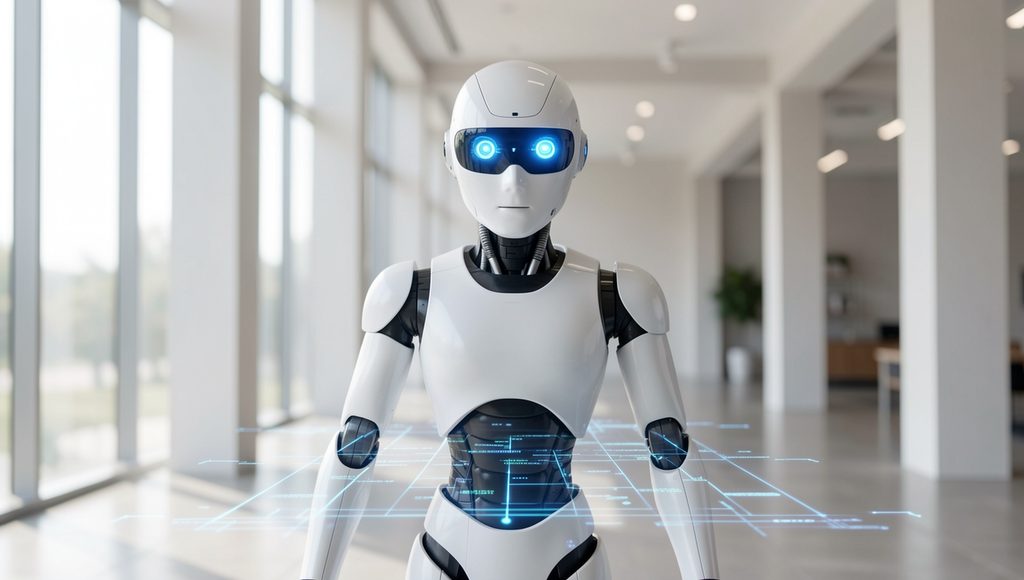
Robot Navigation Using Vision
Discover how robots use cameras, computer vision, depth information, and intelligent algorithms to understand their surroundings and navigate safely through indoor and outdoor environments.
Robot navigation using vision is a technique in which robots use cameras and vision-processing algorithms to understand their environment and determine where they should move. Instead of depending entirely on traditional sensors, a vision-based robot can analyze images and video to detect objects, recognize landmarks, estimate distances, identify obstacles, and support autonomous path planning.
Vision is particularly useful when a robot needs to operate in complex environments where recognizing visual information is important. It can complement technologies such as LiDAR, ultrasonic sensors, wheel encoders, and inertial measurement units.
What Is Vision-Based Robot Navigation?
Vision-based navigation allows a robot to make movement decisions by processing information captured by one or more cameras. The camera continuously observes the environment while software extracts useful information from the visual scene.
The robot can use this information to answer questions such as:
- Where am I?
- What objects are around me?
- Where are the obstacles?
- Which direction should I travel?
- Is the path safe?
- How can I reach my destination?
Vision therefore becomes an important part of the robot’s perception and decision-making system.
How Robot Navigation Using Vision Works
Capture
Camera captures images or video.
Process
Vision software analyzes the image.
Understand
Robot identifies objects and surroundings.
Plan
Navigation software selects a suitable path.
Move
Robot controls its motors and moves.
This process is repeated continuously. As the robot moves, new visual information is collected and the navigation system can update its understanding of the environment.
Important Components
1. Cameras
Cameras provide the visual information required for navigation. A robot may use a monocular camera, stereo cameras, RGB-D cameras, or multiple cameras depending on the application.
2. Computer Vision
Computer vision algorithms process images to detect features, objects, edges, colors, shapes, landmarks, and other useful information.
3. Localization
Localization estimates the robot’s position and orientation within its environment.
4. Mapping
Mapping creates a representation of the environment that can help the robot understand where it has been and where it can go.
5. Path Planning
Path-planning algorithms determine a suitable route from the robot’s current position to its target.
6. Motor Control
Motor controllers convert navigation decisions into wheel, steering, or actuator movements.
Role of Object Detection
Object detection can help a navigating robot understand what is present in front of it. For example, a mobile robot may identify people, furniture, doors, boxes, vehicles, or other robots.
Once an object is detected, the navigation system can determine whether the object represents an obstacle, a destination, or a useful landmark.
Related computer-vision concepts such as object recognition and visual tracking can be incorporated into a broader robot vision system.
Visual Localization
A robot needs to estimate its location before it can reliably navigate. Visual localization uses camera information to estimate the robot’s position relative to known landmarks or previously observed scenes.
The robot may compare current images with previously collected visual information. Recognizable features such as corners, patterns, signs, doors, and other landmarks can help determine the robot’s position.
Obstacle Detection
One of the most important uses of vision in navigation is detecting obstacles. A robot can inspect camera images and determine whether an object is blocking its planned route.
- Detect objects in front of the robot.
- Estimate their position in the scene.
- Identify potentially blocked paths.
- Monitor moving objects.
- Update the navigation path when necessary.
Depth-capable cameras can provide additional information about how far objects are from the robot.
Visual Odometry
Visual odometry estimates the movement of a robot by analyzing changes between successive camera frames. When the robot moves, visual features appear to shift within the camera images.
By tracking these changes, the navigation system can estimate the direction and amount of movement. Visual odometry is especially useful when wheel-based measurements alone are insufficient.
SLAM and Vision-Based Navigation
Simultaneous Localization and Mapping, commonly called SLAM, allows a robot to estimate its position while building a map of an unknown environment.
In visual SLAM, cameras provide much of the information required for identifying visual features, estimating motion, and constructing a map.
Visual SLAM can be useful for robots operating in buildings, warehouses, laboratories, educational environments, and other areas where a robot needs to navigate without a previously prepared map.
Path Planning
After understanding its surroundings, the robot needs to select a route to its destination. Path planning considers the robot’s current position, target position, obstacles, and movement limitations.
A navigation system may continuously update its route when the visual system detects a new obstacle or when the environment changes.
Example: Indoor Delivery Robot
Imagine a delivery robot moving through a building. Its camera observes the hallway while vision algorithms identify people, walls, doors, and obstacles.
If a person suddenly blocks the hallway, the navigation system can recognize the obstruction, evaluate alternative routes, and command the robot to slow down, stop, or move around the obstacle.
Types of Cameras Used in Robot Navigation
| Camera Type | Navigation Use |
|---|---|
| Monocular Camera | General scene understanding and visual feature detection. |
| Stereo Camera | Depth estimation using two camera viewpoints. |
| RGB-D Camera | Provides color images together with depth information. |
| Wide-Angle Camera | Provides a larger field of view for environmental observation. |
| Multiple Cameras | Provides visual coverage from different directions. |
Advantages of Vision-Based Navigation
- Provides rich information about the surrounding environment.
- Can recognize objects and visual landmarks.
- Can support autonomous navigation.
- Can help robots operate in changing environments.
- Can provide useful information for localization and mapping.
- Can complement other robot sensors.
- Can support human-aware navigation in suitable applications.
Challenges
Vision-based navigation also presents several engineering challenges. Camera performance can be affected by environmental and operating conditions.
- Poor lighting can reduce image quality.
- Bright sunlight can create glare and shadows.
- Fast robot movement can cause motion blur.
- Similar-looking environments can make localization difficult.
- Moving people and vehicles can complicate navigation.
- Vision processing can require significant computing resources.
- Camera placement affects the quality of visual information.
Vision Combined With Other Sensors
Many practical robots do not depend on cameras alone. Instead, they combine vision with other sensors to improve navigation reliability.
Vision + LiDAR
Visual information can be combined with distance measurements to improve environmental perception.
Vision + IMU
Camera measurements and inertial information can complement each other when estimating robot motion.
Vision + Wheel Encoders
Visual movement estimates can be compared with wheel motion measurements.
Vision + Ultrasonic Sensors
Cameras can provide scene understanding while ultrasonic sensors provide additional short-range distance information.
Applications
Robot navigation using vision has applications across many robotics fields, including:
- Autonomous mobile robots
- Warehouse robots
- Delivery robots
- Service robots
- Agricultural robots
- Inspection robots
- Educational robots
- Search and exploration robots
- Autonomous vehicles
- Indoor navigation systems
Connection With Robot Vision
Robot navigation is closely connected with the broader field of robot vision. A robot first needs to perceive its environment before it can make intelligent navigation decisions.
For more robotics learning resources, visit Robotics Engineering Courses .
Conclusion
Robot navigation using vision combines cameras, computer vision, localization, mapping, path planning, and motion control to help robots move autonomously through their environments.
By interpreting visual information, a robot can detect obstacles, recognize landmarks, estimate movement, understand its surroundings, and select safer routes. As vision systems become more capable, camera-based navigation is becoming an increasingly important part of modern autonomous robotics.