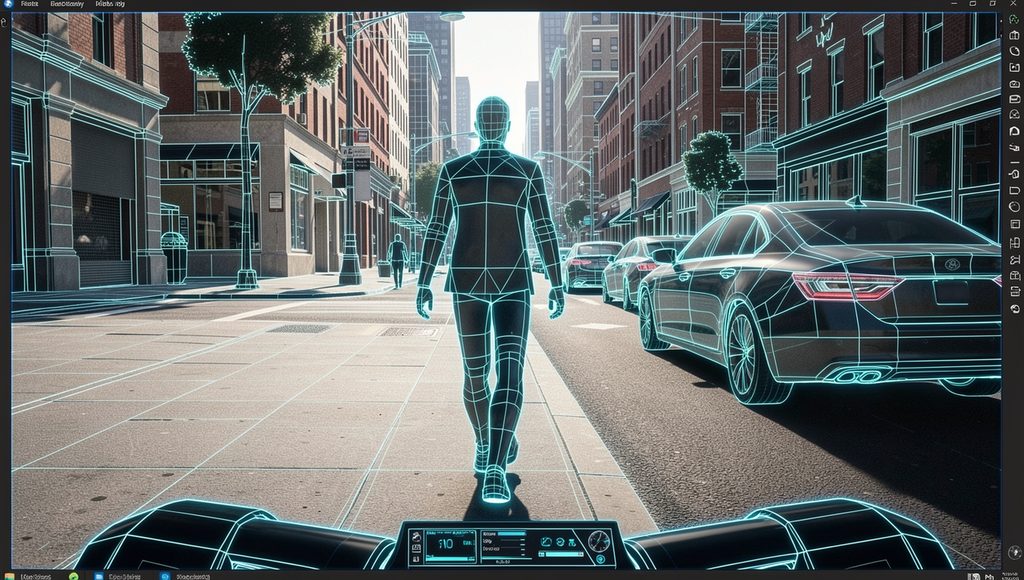
Edge Detection in Robot Vision
Edge detection is an important computer vision technique that helps robots identify object boundaries, shapes, surfaces, and structural features from camera images.
What Is Edge Detection?
Edge detection is a computer vision process used to locate areas in an image where brightness, color, or intensity changes significantly. These changes often correspond to the boundaries of objects, surfaces, or important structures.
In robot vision, edge detection helps a robot transform a complex camera image into useful geometric information. Instead of processing every pixel equally, the robot can focus on important features such as object boundaries, corners, lines, and contours.
Edge detection can therefore serve as an early stage in robotic perception systems and can support object recognition, navigation, inspection, manipulation, and measurement.
Why Edge Detection Is Important in Robot Vision
A robot operating in the physical world needs to understand the structure of its surroundings. Raw camera images contain large amounts of information, including lighting variations, textures, colors, and shadows.
Edge detection reduces some of this complexity by highlighting significant intensity transitions. The resulting edge information can then be used by other vision algorithms.
Object Boundaries
Edges can reveal where one object ends and another surface begins, helping robots estimate object shapes and boundaries.
Shape Analysis
Detected edges can be combined into contours that describe the geometric structure of objects.
Feature Extraction
Lines, corners, contours, and other visual features can be extracted from edge information for robotic perception.
How Edge Detection Works
A typical robot vision pipeline starts with an image captured by a camera. The image may then be processed to reduce noise before an edge detection algorithm identifies significant intensity changes.
Camera captures the environment.
Noise and unwanted variations are reduced.
Important intensity changes are detected.
Lines and contours are extracted.
Vision information supports robot actions.
Common Edge Detection Methods
Different edge detection techniques can be selected depending on the camera, environment, processing requirements, and application.
| Method | Main Characteristics | Robotics Use |
|---|---|---|
| Sobel | Uses image gradients to estimate changes in horizontal and vertical directions. | Useful for basic edge and orientation detection. |
| Prewitt | A simple gradient-based technique for identifying intensity changes. | Suitable for relatively simple vision applications. |
| Roberts | Uses small convolution kernels to detect rapid changes. | Can be useful where computational simplicity is important. |
| Canny | Uses multiple stages to produce relatively well-defined edges while reducing noise. | Widely useful for object boundaries, contours, and robotic perception. |
| Laplacian | Detects rapid changes using a second-order derivative. | Can highlight fine image structures and boundaries. |
Edge Detection Pipeline for a Robot
A practical robot vision system may combine edge detection with several other computer vision operations. A simplified pipeline can include:
- Capture an image using a robot-mounted camera.
- Convert the image to a suitable representation, such as grayscale.
- Reduce image noise using an appropriate filtering technique.
- Apply an edge detection algorithm.
- Remove unwanted or weak edges when necessary.
- Connect edge pixels into meaningful contours.
- Analyze lines, shapes, corners, or object boundaries.
- Use the extracted information for robot perception and control.
Applications of Edge Detection in Robotics
Edge Detection and Object Recognition
Edge detection alone does not normally tell a robot exactly what an object is. Instead, it provides visual features that can be combined with contour analysis, shape recognition, feature descriptors, or machine learning.
For example, a robot inspecting manufactured components may detect the edges of a circular part. The contour can then be analyzed to determine whether its dimensions and shape match the expected component.
Advantages of Edge Detection
- Reduces complex images to important structural features.
- Can help identify object boundaries.
- Useful for shape and contour analysis.
- Can support industrial inspection systems.
- Can provide useful information for navigation.
- Can be computationally efficient compared with processing complete images.
- Can serve as an input to higher-level robot vision algorithms.
Challenges in Robot Vision
Edge detection can become difficult when robots operate in changing real-world environments. A vision system must distinguish meaningful object boundaries from unwanted image features.
- Lighting changes: Shadows and illumination changes can create unwanted edges.
- Image noise: Camera noise can produce false edge responses.
- Low contrast: Object boundaries may be difficult to detect.
- Texture: Complex surfaces may contain many irrelevant edges.
- Motion blur: Moving robots or objects can make edges less distinct.
- Occlusion: Objects may be partially hidden from the camera.
- Processing requirements: Real-time robots often require fast vision processing.
Edge Detection with Other Robot Vision Techniques
Edge detection becomes more powerful when combined with other vision techniques. For example, a robot may use edge detection to identify boundaries and then use object recognition to classify the detected object.
It can also be combined with depth perception, motion detection, visual tracking, and visual SLAM to build a more complete understanding of the robot’s environment.
Explore more robotics and computer vision topics on Robotics Engineering Courses .
Future of Edge Detection in Robotics
Modern robots increasingly combine traditional computer vision techniques with artificial intelligence and machine learning. Edge information can remain useful as a low-level visual feature even when more advanced perception systems are used.
Future robotic systems may combine high-resolution cameras, depth sensors, real-time processors, and intelligent vision models to detect object boundaries more reliably in complex environments.
Learn More About Robotics Vision
Explore additional robotics, automation, computer vision, and human-robot interaction topics.
Explore Robotics Engineering Courses