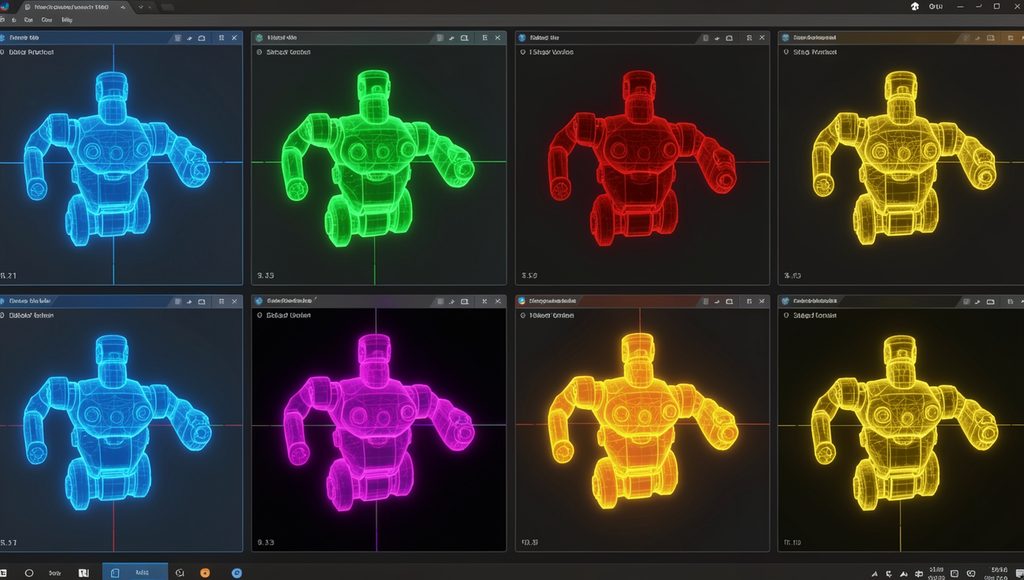
Image Segmentation for Robots
Image segmentation helps robots divide camera images into meaningful regions and identify objects, surfaces, obstacles, and other parts of their environment.
What Is Image Segmentation?
Image segmentation is a computer vision technique that divides an image into meaningful regions by assigning pixels to specific classes or objects. For robots, segmentation provides a more detailed understanding of what appears in front of a camera.
A robot can use image segmentation to distinguish a person from a wall, a product from a conveyor belt, an obstacle from the floor, or a crop from surrounding soil.
Types of Image Segmentation
Semantic Segmentation
Semantic segmentation assigns a class to every pixel. For example, pixels may be classified as road, floor, person, vehicle, wall, or vegetation.
Instance Segmentation
Instance segmentation identifies individual objects. If several boxes appear in a scene, the system can distinguish each box as a separate object.
Panoptic Segmentation
Panoptic segmentation combines semantic understanding with individual object identification to create a detailed representation of a complete scene.
Binary Segmentation
Binary segmentation separates an image into two major regions, such as foreground and background.
How Image Segmentation Works in Robots
A robotic vision system normally processes an image through several stages before the robot uses the segmentation result.
Image Capture
A camera captures an image or video of the robot’s environment.
Preprocessing
The image may be resized, normalized, filtered, or enhanced before segmentation.
Segmentation
A segmentation algorithm separates pixels into meaningful classes or objects.
Scene Understanding
The robot interprets the segmented regions and their relationships within the environment.
Robot Action
The robot uses the visual information for navigation, manipulation, inspection, or interaction.
Techniques Used for Image Segmentation
Thresholding
Thresholding separates pixels according to brightness, intensity, or other numerical values. It can be useful when the object has a strong contrast with its background.
Region-Based Segmentation
Similar neighboring pixels are grouped into regions according to characteristics such as color, intensity, or texture.
Edge-Based Segmentation
Edges and boundaries are detected to help identify the limits of objects and regions within an image.
Deep Learning
Deep learning models can learn complex visual features and produce detailed segmentation maps for difficult real-world robotic environments.
Applications of Image Segmentation in Robotics
1. Robotic Object Picking
Industrial robots can segment objects on a conveyor belt or work surface and use the segmented regions to determine where objects are located.
2. Autonomous Navigation
Mobile robots can segment floors, roads, obstacles, walls, vegetation, and other environmental regions to improve navigation decisions.
3. Industrial Inspection
Manufacturing robots can use segmentation to isolate products, components, defects, and regions that require inspection.
4. Agricultural Robots
Agricultural robots can distinguish crops, soil, weeds, fruits, and other objects to support automated farming operations.
5. Service Robots
Indoor service robots can segment people, furniture, floors, doors, and other environmental features.
6. Robotic Manipulation
Segmentation can help a robot determine the shape and location of objects before attempting to grasp or manipulate them.
Benefits of Image Segmentation for Robots
| Benefit | Robotic Use |
|---|---|
| Object Separation | Helps robots distinguish individual objects within a scene. |
| Scene Understanding | Provides detailed information about the robot’s environment. |
| Navigation | Helps identify free space, obstacles, floors, and other regions. |
| Manipulation | Helps robots locate objects for grasping and handling. |
| Inspection | Allows robots to isolate products and potentially defective regions. |
Challenges of Image Segmentation
Real-world robotic environments can be difficult for image segmentation systems. Changes in lighting, object appearance, background complexity, and camera movement can affect the segmentation result.
- Changing lighting conditions
- Shadows and reflections
- Objects partially hidden by other objects
- Similar colors between objects and backgrounds
- Transparent and reflective objects
- Fast-moving objects
- Complex environments
- Limited robot computing resources
- Need for real-time processing
Image Segmentation and Robot Vision
Image segmentation is an important part of a complete robot vision system. It can work together with object detection, depth perception, visual tracking, localization, and navigation.
For example, a mobile robot can use a camera to capture its surroundings, segment the floor and obstacles, estimate the location of important objects, and then use this information to select an appropriate path.
Learn more about robotics and engineering topics at Robotics Engineering Courses .
Conclusion
Image segmentation allows robots to transform camera images into meaningful regions representing objects, surfaces, obstacles, and other parts of the environment.
From industrial robots and autonomous vehicles to agricultural and service robots, segmentation can improve perception and support intelligent robotic actions.
As robotic vision systems become more advanced, accurate and efficient image segmentation will remain an important technology for autonomous machines.