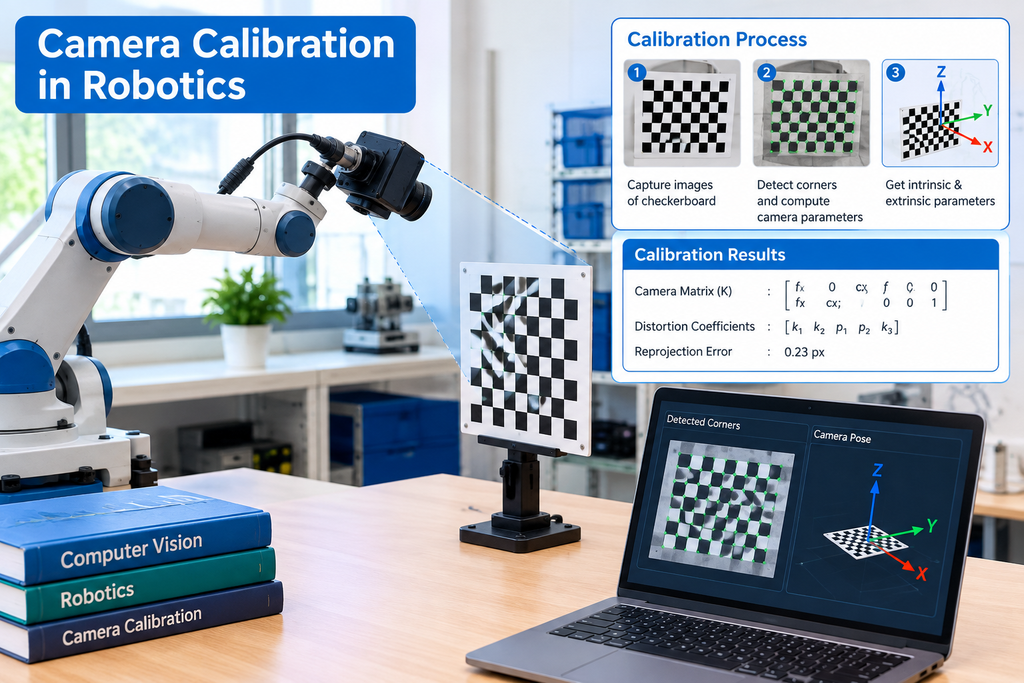
Camera Calibration in Robotics
Understanding camera parameters, lens distortion, and accurate robot vision
What Is Camera Calibration in Robotics?
Camera calibration is the process of determining the mathematical parameters of a camera so that images captured by the camera can be accurately interpreted by a robot. Calibration is an important part of robotic vision because cameras introduce optical and geometric effects that can cause objects to appear different from their real-world positions.
A calibrated camera allows a robot vision system to estimate object position, measure distances, detect features, and relate image coordinates to the physical environment more accurately.
Why Camera Calibration Is Important
A robot may use cameras for navigation, inspection, object recognition, manipulation, tracking, and measurement. If the camera is not properly calibrated, image measurements can contain significant errors.
For example, a robot arm using a camera to locate a component may calculate an incorrect position if the camera’s focal length, optical center, or lens distortion has not been properly determined.
Main Camera Calibration Parameters
Camera calibration generally involves determining intrinsic and distortion parameters. Robotics applications may also require extrinsic calibration to determine the camera’s position and orientation relative to the robot or another coordinate system.
| Parameter | Description | Importance in Robotics |
|---|---|---|
| Focal Length | Describes the camera’s imaging scale. | Important for estimating geometry and depth. |
| Principal Point | Represents the optical center of the image. | Helps relate image coordinates to camera geometry. |
| Lens Distortion | Describes geometric deformation caused by the lens. | Important for accurate measurements and feature positions. |
| Camera Pose | Describes camera position and orientation. | Allows image information to be related to robot coordinates. |
Intrinsic Camera Calibration
Intrinsic calibration determines properties that belong to the camera itself. These parameters describe how three-dimensional points are projected onto the camera image.
Important intrinsic parameters include focal length, principal point, and sometimes skew. These values are normally represented using a camera intrinsic matrix.
[ 0 fy cy ]
[ 0 0 1 ]
Here, fx and fy represent focal length in image-coordinate units, while cx and cy represent the principal point. The parameter s represents image-axis skew.
Lens Distortion
Real camera lenses do not produce a perfectly ideal projection. Straight lines near the edges of an image can appear curved or displaced. This effect is known as lens distortion.
Radial Distortion
Radial distortion changes the apparent position of image points according to their distance from the optical center. It can produce barrel-shaped or pincushion-shaped images.
Tangential Distortion
Tangential distortion can occur when the camera lens and imaging sensor are not perfectly aligned. It causes image points to shift in a direction related to the sensor geometry.
Correcting lens distortion is especially important when a robot performs precision measurement, object localization, or visual manipulation.
Calibration Pattern
A known calibration pattern can be placed in front of the camera. The robot vision system detects known points or geometric features in the pattern and compares their known positions with their positions in the captured image.
A grid-based pattern is commonly used because its geometric structure provides many reference points for calibration.
Basic Camera Calibration Process
Mount the camera securely and ensure that the lens, focus, resolution, and image settings are appropriate for the robotic application.
Use a target containing accurately known geometric points or a regular grid.
Capture the calibration target at different positions and orientations within the camera’s field of view.
Identify the known points or corners of the calibration target in each image.
Use the known target geometry and detected image coordinates to estimate intrinsic and distortion parameters.
Test the resulting calibration using additional images and determine whether the remaining projection error is acceptable for the robotic task.
Extrinsic Camera Calibration
Intrinsic calibration describes the camera itself, while extrinsic calibration determines the camera’s position and orientation relative to another coordinate system.
In robotics, this can be particularly important when a camera is mounted on a robot arm or positioned around a robot workcell. The vision system must know how camera coordinates relate to robot coordinates.
Hand-Eye Calibration
Hand-eye calibration is used when a camera and robotic manipulator must work together. The calibration establishes the geometric relationship between the camera coordinate system and the robot’s coordinate system.
Accurate hand-eye calibration can allow a robot to use visual information to locate an object and then move its end effector to the appropriate position.
Camera Calibration in Robot Applications
- Robot arm object picking
- Industrial inspection
- Robot navigation
- Visual localization
- Object measurement
- Assembly operations
- Object tracking
- Autonomous mobile robots
- Quality-control systems
- Vision-guided manipulation
Calibration Errors
Several factors can reduce calibration accuracy. These include poor image quality, inaccurate calibration targets, insufficient viewpoints, incorrect feature detection, camera movement, lens changes, and mechanical vibration.
A camera that moves after calibration may require recalibration because its relationship with the robot or work environment has changed.
How to Improve Calibration Accuracy
- Use a high-quality calibration target.
- Capture images from many different viewpoints.
- Cover a large portion of the camera’s field of view.
- Avoid blurred calibration images.
- Keep the camera firmly mounted.
- Use consistent camera settings.
- Check calibration error after estimation.
- Repeat calibration if the camera position changes.
Camera Calibration and Robot Vision
Camera calibration provides an important foundation for robot vision. Image processing algorithms can detect edges, objects, features, and patterns, but the accuracy of the resulting spatial information depends strongly on the quality of the camera model.
When calibration is combined with image processing, depth estimation, object detection, tracking, and robot coordinate transformations, a robot can make more reliable decisions based on visual information.
Simple Example
Consider a robotic arm that must pick a small object from a conveyor belt. A camera observes the conveyor and identifies the object’s image coordinates. Calibration allows the system to account for camera geometry and distortion. Extrinsic or hand-eye calibration can then relate the detected object position to the robot’s coordinate system.
The robot can consequently calculate where the object is located and move its end effector toward the required position.
Conclusion
Camera calibration in robotics determines the parameters needed to accurately interpret images captured by a robot camera. Intrinsic parameters describe camera geometry, distortion parameters describe lens effects, and extrinsic calibration relates the camera to the robot or its environment.
Proper calibration improves the reliability of robotic perception, measurement, navigation, inspection, and vision-guided manipulation. For many robot vision applications, accurate calibration is an essential first step before deploying advanced visual algorithms.
Quick Quiz
1. What is the main purpose of camera calibration?
2. Which effect can calibration help correct?
3. What does extrinsic calibration help determine?