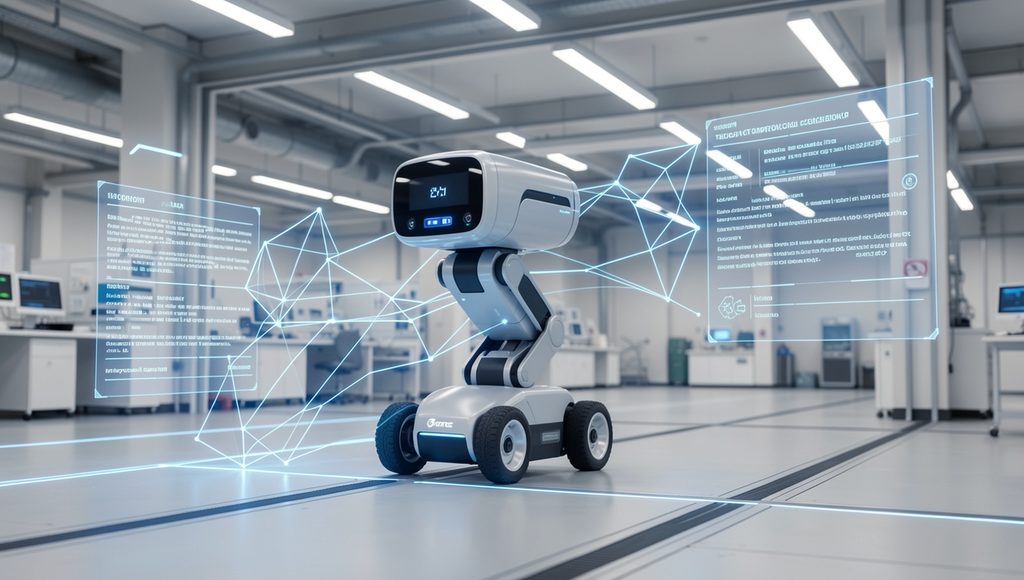
AI-Based Robot Path Planning
Learn how artificial intelligence helps robots find efficient, safe, and adaptive paths through complex environments.
What Is AI-Based Robot Path Planning?
AI-based robot path planning is the process of using artificial intelligence techniques to determine how a robot should move from a starting position to a target destination. The planner considers obstacles, the robot’s capabilities, sensor data, environmental conditions, and the desired objective.
Traditional path-planning algorithms can solve many structured environments, while AI can help robots handle uncertain, changing, and complex environments. An intelligent planner may learn from previous experiences and adjust its path as new information becomes available.
Why AI Is Useful for Robot Path Planning
Obstacle Avoidance
AI can help a robot identify obstacles and select alternative routes when its original path becomes blocked.
Dynamic Environments
Intelligent planning can respond to moving people, vehicles, other robots, and changing workspace conditions.
Path Optimization
AI can optimize routes according to distance, travel time, energy consumption, safety, or several objectives together.
Learning From Experience
Machine-learning methods can allow robots to improve their navigation decisions using information from previous tasks.
Main Components of an AI Path-Planning System
1. Robot Localization
The robot needs an estimate of its current position and orientation. Localization can use information from sensors and a map of the environment.
2. Environment Representation
The environment may be represented using a grid map, occupancy map, geometric model, landmarks, or another suitable representation.
3. Perception
Cameras, depth sensors, LiDAR, ultrasonic sensors, and other sensing technologies can provide information about obstacles and the surrounding environment.
4. Path Planner
The planning system calculates a possible route between the current position and the target. AI can be combined with conventional planning algorithms to improve decision-making.
5. Motion Controller
After a path is selected, the controller generates commands that make the robot follow the planned trajectory.
AI Techniques Used in Robot Path Planning
| Technique | Basic Idea | Possible Application |
|---|---|---|
| Machine Learning | Learns useful patterns from previously collected data. | Navigation decisions and route prediction. |
| Reinforcement Learning | Learns actions by receiving rewards or penalties. | Adaptive navigation in changing environments. |
| Neural Networks | Learns complex relationships between sensor information, robot state, and navigation decisions. | Perception and learned navigation policies. |
| Evolutionary Algorithms | Searches for increasingly better solutions through selection and variation. | Multi-objective path optimization. |
| Hybrid AI Planning | Combines AI with established planning and control methods. | Reliable autonomous robot navigation. |
How AI-Based Path Planning Works
- Sense the Environment: The robot collects information from its available sensors.
- Estimate Robot Position: The system determines where the robot is located within its environment.
- Identify Obstacles: Perception algorithms identify objects and areas that the robot should avoid.
- Generate Candidate Paths: The planner considers possible routes between the current position and the destination.
- Evaluate Paths: Candidate paths can be evaluated according to distance, collision risk, energy use, time, and other objectives.
- Select a Path: The planning system chooses an appropriate route.
- Execute and Monitor: The robot follows the route while continuously monitoring environmental changes.
- Replan When Necessary: If an obstacle appears or conditions change, the robot can calculate a new route.
AI and Traditional Path-Planning Algorithms
Classical algorithms such as graph-search and sampling-based planners can be very effective when the environment and robot model are well defined. AI does not necessarily replace these methods. Instead, AI can complement them by improving perception, estimating costs, predicting environmental changes, or selecting useful planning strategies.
A hybrid architecture can therefore combine a conventional planner for predictable geometric constraints with AI-based decision-making for uncertain situations.
Example: Mobile Robot in a Warehouse
Imagine an autonomous warehouse robot that must transport a box from one location to another. The robot initially calculates a route using its map.
During movement, another robot enters the planned route. The perception system detects the new obstacle. The AI-based navigation system evaluates alternative routes and selects one that avoids the obstacle while attempting to minimize additional travel distance and time.
This process illustrates an important advantage of intelligent navigation: the robot can continuously adapt instead of blindly following a fixed route.
Applications of AI-Based Robot Path Planning
Autonomous Vehicles
Planning safe routes for autonomous ground vehicles and mobile robotic platforms.
Warehouse Robots
Finding efficient routes for transporting products and materials.
Service Robots
Helping indoor robots navigate homes, hospitals, hotels, offices, and public spaces.
Search and Rescue
Supporting navigation through environments where obstacles and conditions may change unexpectedly.
Industrial Robots
Optimizing movement between work areas while considering workspace constraints.
Multi-Robot Systems
Helping several robots coordinate movement and reduce conflicts within a shared environment.
Challenges
AI-based path planning must balance computational speed, safety, reliability, and adaptability. A planner that produces an excellent route but takes too long to calculate may not be useful for a fast-moving robot.
Other challenges include incomplete sensor information, uncertain obstacle movement, limited computing resources, localization errors, narrow spaces, and the need for predictable robot behavior.
AI-Based Robot Path Planning and the Future
Future robotic systems are likely to combine perception, localization, mapping, machine learning, planning, and motion control into increasingly integrated autonomous systems. Robots may use learned models to predict how environments will change and conventional planning techniques to maintain geometric and safety constraints.
For robotics engineers, understanding both AI methods and classical planning concepts is valuable for developing reliable autonomous robots.
Quick Quiz
1. What is the main purpose of robot path planning?
2. Why can AI be useful in changing environments?
3. What may cause a robot to replan its path?
Explore More Robotics Topics
Continue learning about robotics, autonomous systems, artificial intelligence, sensing, perception, and robot decision-making through Robotics Engineering Courses .
You can also explore the Artificial Intelligence for Robotics section for related learning topics.