AI-Based Object Recognition
Learn how artificial intelligence enables robots to identify, classify, and understand objects in their surroundings.
What Is AI-Based Object Recognition?
AI-based object recognition is a robotics technology that allows a robot to identify objects from images or video captured by cameras and other vision sensors. Instead of simply detecting shapes or colors, an AI-enabled robot can learn visual patterns and determine what an object is.
For example, a mobile robot operating in a warehouse may recognize boxes, people, shelves, pallets, tools, or packages. This ability allows the robot to make better decisions while navigating, picking objects, avoiding obstacles, and interacting with people.
How Object Recognition Works in Robots
A typical AI-based object recognition system combines a camera, image-processing software, machine-learning algorithms, and the robot’s control system.
Object Detection and Object Recognition
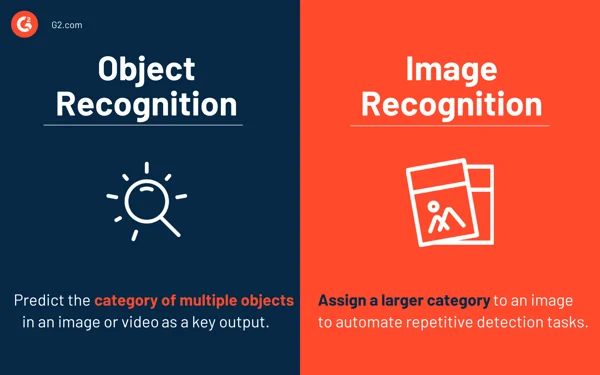
Object detection and object recognition are closely related but serve different purposes. Object detection generally determines where an object is located in an image, often using a bounding region. Object recognition goes further by determining the identity or category of the detected object.
Example
Suppose a service robot sees a table containing a cup, bottle, and book. The vision system may first detect the separate objects and then classify them as a cup, bottle, and book. The robot can subsequently use this information to perform a task such as picking up the cup.
AI Models for Object Recognition
Modern robotics systems can use machine-learning and deep-learning models to recognize objects. These models are trained using large collections of labeled images so that they learn useful visual characteristics.
- Image classification: Determines the main object category in an image.
- Object detection: Locates and classifies multiple objects.
- Instance recognition: Helps distinguish individual objects of the same category.
- Semantic understanding: Assigns meaningful categories to visual regions.
- Deep learning: Learns complex visual features automatically from training data.
Role of Cameras and Vision Sensors
Cameras provide the visual information required by an AI object recognition system. Depending on the application, robots may use conventional RGB cameras, stereo cameras, depth cameras, or other vision sensors.
The quality of the captured image can strongly influence recognition performance. Lighting, camera position, object size, shadows, reflections, motion blur, and partial occlusion can all affect recognition accuracy.
Object Recognition Pipeline
Camera → Image Processing → AI Model → Object Detection → Classification → Confidence Evaluation → Robot Decision → Action
This pipeline allows a robot to convert raw visual information into useful information for autonomous operation. The recognition result can then be connected to navigation, manipulation, or human-robot interaction systems.
Applications of AI-Based Object Recognition
- Warehouse robots identifying packages and containers
- Industrial robots recognizing components on production lines
- Service robots identifying household objects
- Agricultural robots recognizing fruits, plants, and weeds
- Healthcare robots identifying objects in clinical environments
- Autonomous mobile robots recognizing people and obstacles
- Educational robots detecting and classifying demonstration objects
- Robotic arms locating objects for automated picking
Challenges in AI Object Recognition
Robots operate in environments that can change continuously. Therefore, object recognition must remain reliable under different visual conditions.
- Low or changing illumination
- Objects partially hidden behind other objects
- Different object sizes and orientations
- Similar-looking objects
- Moving objects and motion blur
- Reflective or transparent surfaces
- Limited computing resources on small robots
- Insufficient or unbalanced training data
Object Recognition and Robot Manipulation
Object recognition becomes particularly useful when combined with robotic manipulation. A robot can recognize an object, estimate its location, plan a movement, and control its robotic arm or gripper to interact with it.
For example, a warehouse robot may identify a particular package among many packages. The recognition result can be passed to the manipulation system, which calculates how the gripper should approach and grasp the package.
Improving Recognition Accuracy
- Use high-quality and appropriately positioned cameras.
- Provide diverse training images.
- Include different lighting and viewing angles during training.
- Use suitable image preprocessing techniques.
- Choose an AI model appropriate for the robot’s hardware.
- Continuously test recognition in the robot’s real operating environment.
- Combine visual recognition with depth and other sensor information when necessary.
Future of AI-Based Object Recognition in Robotics
AI-based object recognition is becoming an important part of intelligent robotics. Future robots are expected to recognize increasingly complex objects, understand their context, and use visual information together with language, spatial information, and other sensor data.
As recognition systems become more capable, robots can move from simple programmed operations toward more flexible autonomous tasks. This is particularly important for service robotics, industrial automation, logistics, healthcare, agriculture, and human-robot collaboration.
Quick Quiz
1. What is the main purpose of AI-based object recognition?
2. Which component commonly provides visual information to a robot?
3. Why is training data important for AI object recognition?
Explore More Robotics Topics
Continue learning about artificial intelligence and robotics through the Artificial Intelligence for Robotics section.
Visit the Robotics Engineering Courses homepage for more educational articles about robotics, perception, sensing, autonomous systems, and robot intelligence.