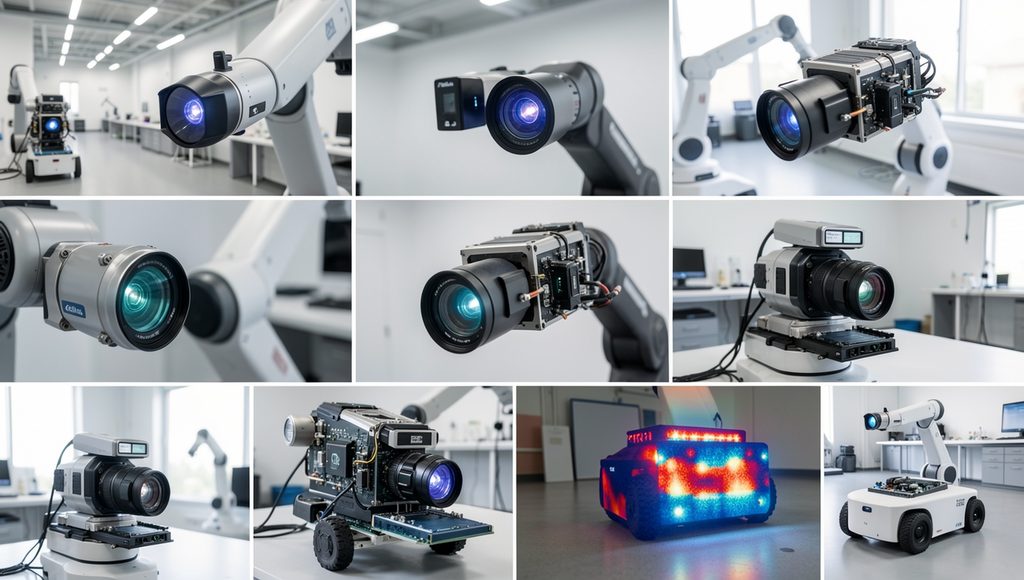
Cameras Used in Robotics
Understanding the role of cameras in robot vision, perception, navigation, and object recognition.
Cameras are important sensors in modern robotics. They allow robots to observe their surroundings and collect visual information about objects, people, surfaces, obstacles, and environments.
Robot cameras can be used for tasks such as object detection, navigation, inspection, measurement, manipulation, mapping, and human-robot interaction. Different robotic applications require different types of cameras depending on lighting, distance, accuracy, speed, and environmental conditions.
Why Cameras Are Used in Robotics
A robot needs information about its environment to make decisions. Cameras provide visual data that can be processed by computer vision and artificial intelligence algorithms.
- Detecting and recognizing objects
- Identifying people and human activities
- Estimating object position and distance
- Supporting robot navigation
- Creating maps of environments
- Inspecting machines and manufactured products
- Guiding robotic arms during manipulation
- Monitoring changes in the environment
Main Types of Cameras Used in Robotics
1. RGB Cameras
RGB cameras capture normal color images using red, green, and blue channels. They are among the most common cameras used in robotic vision.
- Object recognition
- Color detection
- Image classification
- Visual inspection
2. Monocular Cameras
A monocular camera uses a single lens to capture images. It provides useful visual information but does not directly measure depth like a dedicated depth sensor.
- Robot monitoring
- Object detection
- Visual tracking
- Navigation assistance
3. Stereo Cameras
Stereo cameras use two or more viewpoints to estimate depth. They work in a similar way to human binocular vision.
- Depth estimation
- Obstacle detection
- 3D perception
- Robot navigation
4. Depth Cameras
Depth cameras provide information about the distance between the camera and objects in the scene. This makes them useful for three-dimensional robotic perception.
- 3D mapping
- Object localization
- Obstacle avoidance
- Robot manipulation
5. Thermal Cameras
Thermal cameras detect infrared radiation and produce images based on temperature differences. They can help robots operate in conditions where ordinary cameras are less useful.
- Heat detection
- Industrial inspection
- Fire monitoring
- Night-time applications
6. Infrared Cameras
Infrared cameras detect infrared wavelengths and can be used for perception in low-light environments and specialized sensing applications.
- Low-light vision
- Object detection
- Security robots
- Night navigation
7. Event Cameras
Event cameras respond to changes in brightness rather than capturing traditional frames. They can provide very fast visual information for high-speed robotic applications.
- High-speed motion tracking
- Fast-moving robots
- Motion detection
- Dynamic environments
8. Pan-Tilt Cameras
Pan-tilt cameras can rotate horizontally and vertically. They give robots a larger field of view without requiring the entire robot to move.
- Surveillance robots
- Telepresence robots
- Human tracking
- Large-area observation
Comparison of Robotic Cameras
| Camera Type | Main Capability | Typical Robotics Use |
|---|---|---|
| RGB Camera | Color and image capture | Object recognition and inspection |
| Monocular Camera | Single-view visual information | Tracking and perception |
| Stereo Camera | Depth estimation | Navigation and 3D perception |
| Depth Camera | Distance measurement | Mapping and obstacle avoidance |
| Thermal Camera | Temperature-based imaging | Inspection and heat detection |
| Infrared Camera | Infrared imaging | Low-light perception |
| Event Camera | Fast brightness-change detection | High-speed motion tracking |
| Pan-Tilt Camera | Adjustable viewing direction | Surveillance and telepresence |
Applications of Cameras in Robotics
Robot Navigation
Cameras help mobile robots identify obstacles, recognize landmarks, estimate their surroundings, and support navigation through indoor and outdoor environments.
Object Recognition
Vision systems can identify objects and determine their location. This is particularly useful for warehouse robots, service robots, and robotic manipulators.
Industrial Inspection
Cameras can inspect products for defects, incorrect assembly, surface problems, missing components, and other manufacturing issues.
Robotic Manipulation
A robotic arm can use cameras to locate an object, estimate its position, and guide the end effector toward the desired target.
Human-Robot Interaction
Cameras can help robots detect people, track movement, recognize gestures, and understand visual aspects of human interaction.
Factors to Consider When Selecting a Robot Camera
- Resolution: Higher resolution can provide more visual detail.
- Frame rate: Important when robots need to observe fast movement.
- Field of view: Determines how much of the environment the camera can see.
- Depth capability: Useful for 3D perception and distance estimation.
- Lighting: The camera should match the expected lighting conditions.
- Operating environment: Industrial robots may require cameras designed for dust, vibration, or temperature variations.
- Processing requirements: Camera data must be processed by suitable robotic computing hardware.
- Latency: Low latency can be important for real-time robotic control.
Cameras and Computer Vision in Robotics
A camera is only one part of a robotic vision system. The captured images normally need to be processed by computer vision algorithms. These algorithms can detect objects, identify patterns, estimate positions, track movement, and extract useful information from images.
Modern robots increasingly combine cameras with artificial intelligence to improve their ability to interpret complex scenes. Learn more about related robotics concepts through the Robotics Engineering Courses website.