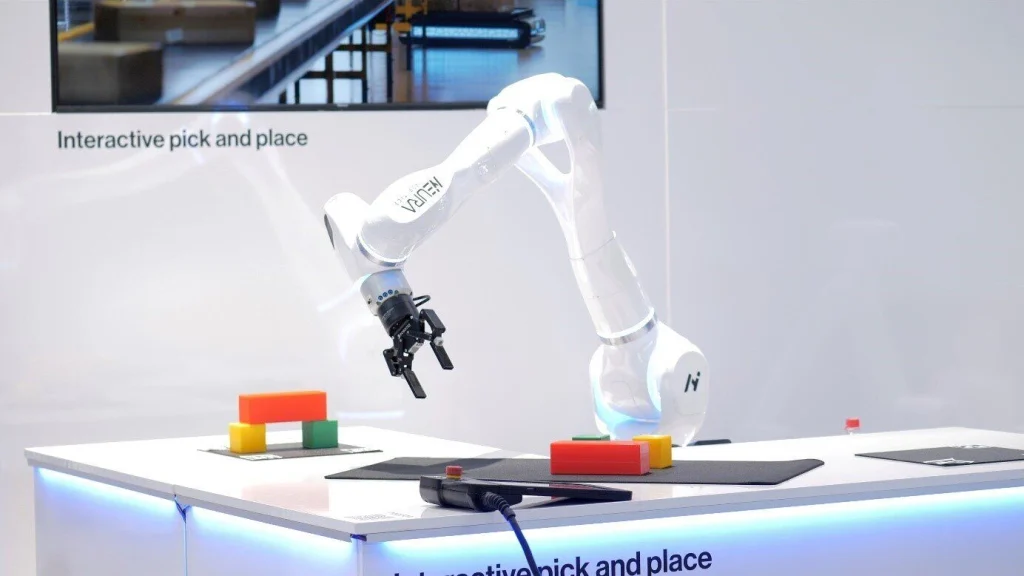
Cognitive Robotics and AI
Understanding how artificial intelligence enables robots to perceive, reason, learn, plan, and act.
What Is Cognitive Robotics?
Cognitive Robotics is an area of robotics that combines artificial intelligence with robotic systems to give machines the ability to interpret their environment, make decisions, learn from experience, and perform tasks intelligently.
How Cognitive Robotics Works
Cognitive robotics connects several AI and robotics technologies into a continuous decision-making system. Sensors collect information from the environment, AI algorithms interpret that information, and the robot selects an appropriate action.
Major Components of Cognitive Robotics
1. Perception
Cameras, depth sensors, microphones, force sensors, and other devices provide information about the robot’s surroundings.
2. AI-Based Recognition
Machine learning and computer vision can help robots recognize objects, people, environments, gestures, and important visual patterns.
3. Knowledge Representation
A cognitive robot can organize information about objects, locations, tasks, relationships, and previous experiences.
4. Reasoning
AI reasoning allows a robot to evaluate information and select actions according to its goals and current situation.
5. Planning
Planning algorithms help robots determine the sequence of actions needed to complete a task.
6. Learning
Robots can improve their behavior using machine learning, reinforcement learning, demonstrations, and accumulated experience.
Role of Artificial Intelligence
Artificial intelligence provides many of the cognitive capabilities used by modern robots. Instead of relying only on fixed rules, an AI-enabled robot can analyze data and adapt its behavior.
- Machine learning for improving robot behavior.
- Computer vision for understanding visual information.
- Natural language processing for human-robot communication.
- AI planning for selecting sequences of actions.
- Decision-making algorithms for handling changing conditions.
- Reinforcement learning for learning through interaction.
Cognitive Robot Decision-Making
Decision-making is a central feature of cognitive robotics. A robot may receive information from multiple sensors and must determine what action is most appropriate.
For example, a service robot moving through a building may detect a person, identify an obstacle, determine its current location, select a safe route, and continue toward its destination.
Cognitive Robotics and Robot Learning
Learning enables robots to become more capable over time. A robot can use previous observations and task outcomes to improve future decisions.
Learning from Demonstration
A human can demonstrate a task while the robot observes the actions. The robot can then attempt to reproduce or generalize the demonstrated behavior.
Reinforcement Learning
In reinforcement learning, a robot can learn through interaction with an environment by receiving feedback associated with its actions.
Experience-Based Learning
Robots can store useful information from previous tasks and use that experience when facing similar situations.
Human-Robot Interaction
Cognitive robotics is particularly important for robots that work alongside humans. A cognitive robot can combine speech, vision, gesture recognition, context understanding, and decision-making to interact more naturally.
This capability is useful in service robotics, healthcare assistance, education, manufacturing, logistics, and domestic applications.
Applications of Cognitive Robotics
- Service Robots: Helping people in homes, offices, and public environments.
- Industrial Robots: Adapting to changing production conditions.
- Healthcare Robots: Supporting selected assistance and rehabilitation tasks.
- Autonomous Vehicles: Perceiving surroundings and making navigation decisions.
- Warehouse Robots: Planning routes and handling changing logistics environments.
- Educational Robots: Supporting interactive learning activities.
- Search and Rescue: Operating in environments that are difficult or dangerous for humans.
Challenges in Cognitive Robotics
Building a robot with human-like cognitive capabilities remains challenging. Robots must operate reliably despite uncertainty, incomplete information, sensor errors, changing environments, and unexpected events.
- Reliable perception in complex environments.
- Fast and safe decision-making.
- Learning without excessive training data.
- Combining information from multiple sensors.
- Understanding human intentions and context.
- Operating safely around people.
- Managing uncertainty in real-world situations.
Future of Cognitive Robotics
Future cognitive robots are expected to become better at combining perception, reasoning, learning, language, memory, and physical action. Instead of performing only narrowly programmed tasks, robots may increasingly adapt their behavior to new environments and user requirements.
The integration of AI with robotics is therefore an important area for students, engineers, and researchers interested in intelligent autonomous systems.
Quick Learning Summary
- Cognitive robotics combines robotics and artificial intelligence.
- Perception allows robots to collect information about their surroundings.
- Reasoning helps robots interpret information and make decisions.
- Planning determines how a robot can achieve a goal.
- Learning allows robots to improve from data and experience.
- Human-robot interaction enables more natural cooperation with people.
Mini Quiz: Cognitive Robotics and AI
1. What is a major goal of cognitive robotics?
2. Which capability allows a robot to improve from experience?
3. What does robot planning determine?