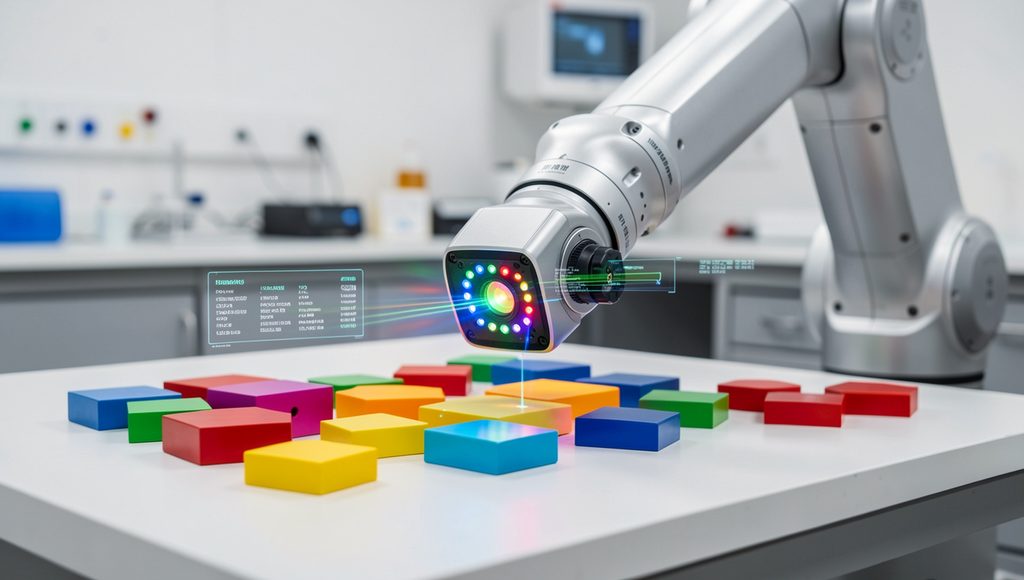
Color Detection in Robotics
Color detection is an important computer vision capability that allows robots to identify and respond to different colors in their environment. By analyzing images captured by cameras or color sensors, a robot can recognize objects, separate materials, follow colored paths, and perform automated tasks with greater accuracy.
What Is Color Detection in Robotics?
Color detection in robotics is the process of identifying specific colors from images or sensor readings. A robot receives visual information through a camera or dedicated color sensor and processes that information to determine the dominant or target colors.
For example, a mobile robot may be programmed to follow a red line, identify a blue object, or separate products according to their color. These capabilities are useful in manufacturing, warehouse automation, agriculture, education, and service robotics.
How Color Detection Works
A typical robotic color detection system follows several stages. The camera captures an image, image-processing software analyzes the pixels, and the robot determines whether the desired color is present.
- Image Capture: A camera or color sensor collects visual data.
- Image Processing: The robot processes the captured image.
- Color Representation: The image may be represented using RGB, HSV, or another color model.
- Color Segmentation: Pixels matching the target color are separated from the background.
- Object Identification: The robot determines the location or shape of the colored region.
- Robot Action: The control system uses the result to perform an appropriate action.
Color Models Used in Robotics
RGB Color Model
RGB represents colors using red, green, and blue components. It is commonly associated with digital cameras and computer displays.
HSV Color Model
HSV represents hue, saturation, and value. It is often useful for color detection because hue provides a convenient way to distinguish different colors.
HSL Color Model
HSL describes color using hue, saturation, and lightness. It can also be useful for applications where brightness needs to be considered separately from color.
Grayscale Processing
Although grayscale does not contain color information, it may be used alongside image-processing techniques to identify boundaries and shapes around colored objects.
Color Segmentation
Color segmentation is a major step in robotic color detection. The system selects pixels that fall within a predefined color range. Pixels outside that range can be treated as background.
For example, if a robot needs to identify a green object, the software can define an acceptable range for green. The resulting segmented region can then be analyzed to determine the object’s position and size.
Why Segmentation Is Important
- Separates target colors from the background.
- Reduces unnecessary visual information.
- Helps locate colored objects.
- Supports object tracking.
- Improves the robot’s decision-making process.
Hardware Used for Color Detection
RGB Cameras
Standard RGB cameras capture images containing red, green, and blue color information and are suitable for many robotic vision applications.
Color Sensors
Dedicated color sensors can detect specific color characteristics and are useful when a full camera-based vision system is not necessary.
Embedded Computers
A processing unit analyzes camera data and runs the color detection algorithms required by the robot.
Robot Controller
The controller receives the detection result and converts it into movement or task instructions.
Applications of Color Detection in Robotics
- Line-Following Robots: Robots can detect colored lines and use them as navigation paths.
- Industrial Sorting: Robots can sort products according to their color.
- Agricultural Robots: Color information can help identify plants, fruits, or areas of interest.
- Warehouse Robots: Colored markers can provide navigation or identification information.
- Educational Robots: Color detection provides an accessible way to teach robotics and computer vision.
- Object Tracking: A robot can follow a moving object based on its distinctive color.
- Quality Inspection: Robots can identify products whose colors differ from an expected range.
Challenges in Robotic Color Detection
Color detection may appear simple, but real-world environments introduce several challenges.
- Lighting Changes: Different lighting conditions can alter the appearance of colors.
- Shadows: Shadows can make the same object appear darker.
- Reflections: Shiny surfaces may create unwanted highlights.
- Background Colors: Similar background and object colors can make segmentation difficult.
- Camera Quality: Low-quality cameras can produce inaccurate color information.
- Color Similarity: Some colors have very similar visual characteristics.
Improving Color Detection Accuracy
Engineers can improve color detection by controlling the environment and optimizing the vision algorithm.
- Use consistent lighting whenever possible.
- Calibrate the camera before deployment.
- Choose suitable color thresholds.
- Use HSV-based processing when appropriate.
- Apply image filtering to reduce noise.
- Combine color information with shape or size detection.
- Use object tracking when detecting moving objects.
- Test the system under different lighting conditions.
Color Detection vs. Object Recognition
| Feature | Color Detection | Object Recognition |
|---|---|---|
| Main Purpose | Identify colors or colored regions | Identify specific objects or object categories |
| Processing Complexity | Usually relatively simple | Usually more complex |
| Typical Input | Camera or color sensor | Camera or other vision sensor |
| Example | Detect a red ball | Recognize a ball as a particular object |
Role of Color Detection in Robot Vision
Color detection is one component of a broader robotic vision system. Robots can combine color information with image processing, object detection, object recognition, depth information, and motion tracking.
To learn more about related robotics vision concepts, explore the robotics engineering articles available on Robotics Engineering Courses.
Conclusion
Color detection provides robots with a practical way to interpret visual information. By using cameras or color sensors, image-processing algorithms, and appropriate color models, robots can identify colored objects and use that information to perform tasks.
From line-following robots and industrial sorting systems to agricultural and educational robots, color detection remains an important technique in robotics. Its effectiveness can be improved through proper camera calibration, lighting control, segmentation, and the combination of color information with other computer vision techniques.