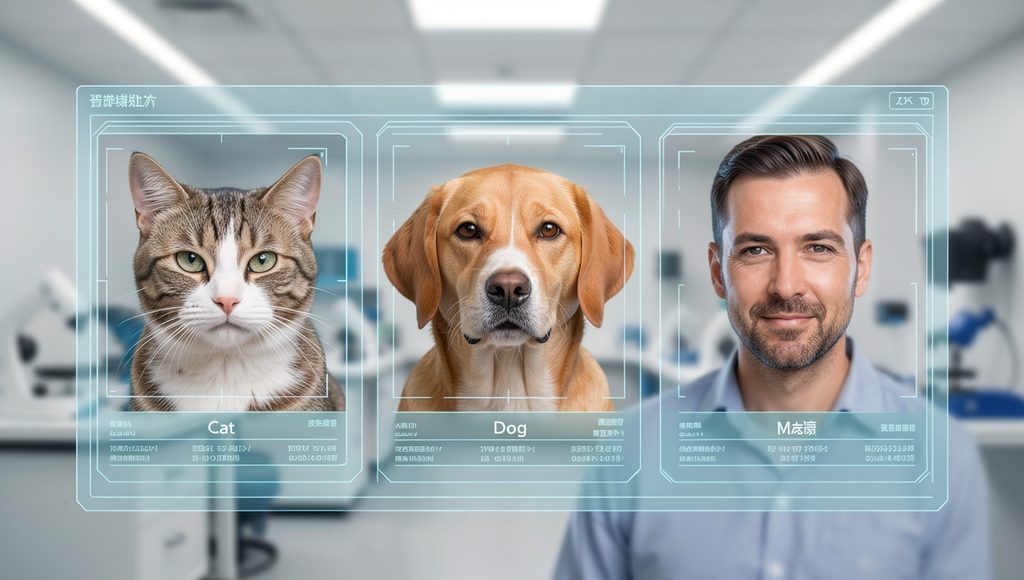
Image Classification for Robots
Image classification enables robots to analyze camera images and identify what objects or visual categories are present in their surroundings. It is an important part of modern robot vision, computer vision, and intelligent automation.
What Is Image Classification?
Image classification is a computer vision technique that allows a robot to assign an image to a particular category. For example, a robot may analyze a camera image and determine whether it contains a bottle, box, person, vehicle, animal, or another object.
In robotics, image classification converts visual information captured by cameras into useful information that a robot can use for navigation, object handling, inspection, security, and decision-making.
How Image Classification Works in Robots
A robotic image-classification system normally combines a camera, image-processing software, a trained machine-learning model, and the robot’s control system.
Image Capture
A camera mounted on the robot captures an image or video frame of the surrounding environment.
Image Preprocessing
The captured image may be resized, normalized, cropped, or enhanced before being processed by the classification model.
Feature Analysis
A computer vision or deep-learning model analyzes visual patterns such as shapes, textures, edges, and colors.
Classification
The model assigns the image to one or more predefined categories and produces confidence scores.
Robot Decision
The robot uses the classification result to select an appropriate action or behavior.
Robot Action
The robot can move, pick an object, avoid an obstacle, inspect a product, or perform another programmed task.
Image Classification and Robot Vision
Robot vision gives machines the ability to obtain useful information from cameras and other visual sensors. Image classification is one component of this larger vision system.
A robot may first classify an image to understand the general category of an object and then use other vision techniques to determine its exact position, size, distance, or movement.
For example, a robot might classify an object as a “bottle” and then use object detection and depth perception to determine where the bottle is located and how far away it is.
Technologies Used for Image Classification
Convolutional Neural Networks
Convolutional Neural Networks, commonly called CNNs, are widely used for visual recognition. They can learn important patterns from large collections of labeled images.
Deep Learning
Deep-learning models can learn complex visual features and are useful when robots need to recognize many different categories under changing lighting, orientation, and environmental conditions.
Transfer Learning
Transfer learning allows a model that has already learned useful visual features to be adapted for a specific robotic application. This can reduce the amount of task-specific training data required.
Edge Computing
Robots often need to process images locally because fast decisions are important. Edge computing can reduce communication delays by allowing image classification to run directly on or near the robot.
Applications of Image Classification in Robotics
Warehouse Robots
Robots can classify packages, containers, products, and storage items to support automated warehouse operations.
Industrial Inspection
Vision-enabled robots can classify products as acceptable or defective during manufacturing and quality-control processes.
Agricultural Robots
Agricultural robots can classify crops, fruits, leaves, weeds, and other objects in farming environments.
Service Robots
Service robots can classify common objects and visual scenes to improve interaction with people and their surroundings.
Security Robots
Autonomous security systems can classify visual scenes and identify categories of objects requiring attention.
Autonomous Vehicles
Vision systems can classify road scenes, vehicles, traffic signs, and other important visual information.
Advantages
- Helps robots understand visual information.
- Supports automated decision-making.
- Can improve industrial inspection.
- Enables robots to recognize different object categories.
- Supports autonomous robotic systems.
- Can operate continuously when integrated with robotic hardware.
Challenges
Image classification in real-world robots can be affected by poor lighting, shadows, object orientation, motion blur, occlusion, reflections, camera quality, and changes in the environment.
Training data is also important. A classification model trained with limited or unrepresentative images may perform poorly when the robot encounters unfamiliar objects or environments.
Image Classification vs. Object Detection
Image classification generally answers the question: “What category is present in this image?”
Object detection goes further by identifying objects and locating them within an image, often using bounding boxes. A robot can combine classification, object detection, segmentation, and depth perception to obtain a more complete understanding of its environment.
Role in Autonomous Robots
Image classification can become part of a larger autonomous robotics pipeline. Camera data can be processed by a vision system, classified by an AI model, and then passed to the robot’s planning and control system.
This allows robots to respond to visual information instead of relying only on predefined movements. As artificial intelligence and computer vision continue to improve, image classification is becoming increasingly useful for intelligent robotic systems.
Learn More About Robotics
Explore more robotics engineering topics, computer vision concepts, and intelligent robotic systems.
Explore Robotics Engineering