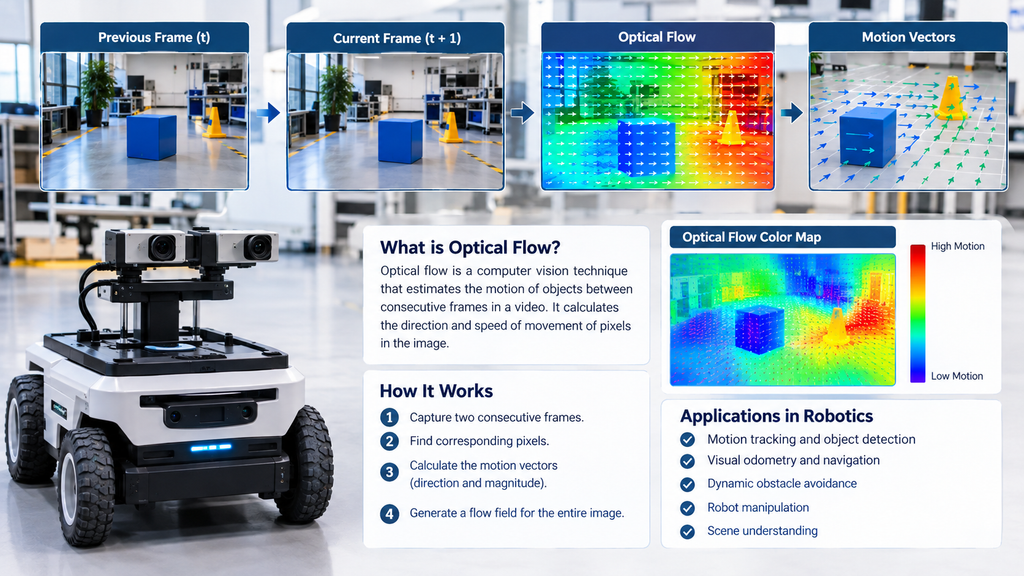
Optical Flow in Robot Vision
Understanding how robots estimate motion from changes in image patterns to improve navigation, tracking, obstacle avoidance, and autonomous decision-making.
What Is Optical Flow?
Optical flow is a computer vision technique used to estimate the apparent motion of objects, surfaces, or visual features between consecutive images. In robot vision, a camera captures a sequence of frames and the robot analyzes how pixels or visual features move from one frame to another.
The estimated motion can provide valuable information about the robot’s movement, the movement of surrounding objects, and the structure of the environment. Optical flow is therefore an important technique for robots operating in dynamic or unknown environments.
How Optical Flow Works
A robot camera continuously captures images as the robot moves. When the position of visual patterns changes between frames, optical flow algorithms estimate the direction and magnitude of that apparent movement.
- The robot camera captures an image.
- A second image is captured shortly afterward.
- Visual features or pixel patterns are compared.
- The displacement of these patterns is estimated.
- The displacement is represented as motion vectors.
- The robot uses the motion information for perception and control.
Each motion vector can contain information about the direction and speed of apparent movement in the image. A collection of vectors produces an optical-flow field.
Optical Flow Field
An optical-flow field represents motion across an entire image. Each point in the image may be associated with a vector showing the estimated direction and amount of displacement.
For example, when a mobile robot moves forward through a hallway, nearby objects may appear to move rapidly outward from the center of the camera image. Distant objects generally exhibit smaller apparent motion.
Types of Optical Flow Methods
1. Sparse Optical Flow
Sparse optical flow tracks selected image features rather than calculating motion for every pixel. Corners, edges, or other distinctive points can be tracked between frames.
2. Dense Optical Flow
Dense optical flow attempts to estimate motion across most or all pixels in an image. This produces a detailed motion field that can be useful for scene understanding and motion analysis.
3. Feature-Based Motion Estimation
Feature-based approaches identify distinctive visual points and follow their positions over time. They can be useful when a robot needs reliable tracking of recognizable structures.
Optical Flow in Mobile Robots
Optical flow can help mobile robots estimate their movement relative to the environment. A forward-moving robot may observe characteristic changes in the visual field that indicate its direction and approximate motion.
This information can complement other sensors such as cameras, inertial sensors, range sensors, and wheel encoders.
Motion Estimation
Optical flow can provide information about the apparent movement of the robot relative to its surroundings.
Obstacle Detection
Unusual or rapidly changing flow patterns can indicate objects approaching the robot.
Navigation
Visual motion information can assist a robot in selecting safe movement directions.
Object Tracking
Moving visual features can be followed across successive camera frames.
Optical Flow for Obstacle Avoidance
Optical flow can help a robot detect objects that are becoming closer. When an obstacle approaches the camera, its image may expand and produce a characteristic flow pattern.
A robot can analyze the magnitude and direction of visual motion to identify potentially dangerous regions. The navigation system can then slow down, change direction, or stop when necessary.
Optical flow is particularly useful for robots that need rapid visual feedback while moving through environments containing obstacles.
Optical Flow and Robot Navigation
Autonomous robots need to understand how their visual environment changes while moving. Optical flow provides a stream of visual motion information that can contribute to navigation systems.
For example, a robot navigating a corridor can compare optical flow on the left and right sides of its camera image. Differences between these regions may provide information about whether the robot is moving closer to one wall than the other.
Optical flow can also complement visual navigation techniques discussed throughout Robotics Engineering Courses .
Applications of Optical Flow in Robotics
| Application | How Optical Flow Helps |
|---|---|
| Mobile Robot Navigation | Provides visual information about apparent environmental motion. |
| Obstacle Avoidance | Helps identify regions with rapidly changing visual motion. |
| Object Tracking | Tracks the movement of objects or visual features between frames. |
| Drone Vision | Can provide motion information during flight and maneuvering. |
| Visual Odometry | Can contribute image-motion information for estimating robot movement. |
| Human-Robot Interaction | Can help detect and track human movement in camera images. |
Advantages of Optical Flow
- Provides useful visual motion information.
- Can operate using camera images.
- Can support real-time robot perception.
- Useful for detecting relative movement.
- Can complement other robotic sensors.
- Useful in navigation and obstacle avoidance.
- Can support tracking of moving objects.
Limitations of Optical Flow
- Performance can decrease in poor lighting.
- Motion blur can make feature tracking difficult.
- Textureless surfaces may provide insufficient visual information.
- Fast movement can produce large image displacements.
- Dynamic objects can complicate motion interpretation.
- Camera noise can affect flow estimation.
- Computational requirements can increase for dense optical flow.
Optical Flow and Other Robot Vision Techniques
Optical flow is normally one component of a larger robot vision system. A robot may combine motion information with image classification, object detection, image segmentation, depth perception, and localization.
Combining multiple vision techniques allows an autonomous robot to obtain a more complete understanding of its environment.
Optical Flow in Autonomous Robots
Autonomous robots require continuous perception while they move. Optical flow can provide a rapid stream of information about visual changes in the environment.
When combined with suitable algorithms and other sensors, optical flow can contribute to perception, localization, navigation, collision avoidance, and interaction with moving objects.
Students learning robot vision can explore additional robotics concepts through the main Robotics Engineering Courses learning platform.
Quick Quiz
1. What does optical flow primarily estimate?
2. Which type of optical flow estimates motion across most image pixels?
3. How can optical flow help a mobile robot?
Conclusion
Optical flow is an important technique in robot vision for estimating apparent motion from consecutive camera images. It can help robots understand movement, detect approaching obstacles, track objects, and support autonomous navigation.
Although optical flow has limitations related to lighting, texture, motion blur, and dynamic scenes, it remains a valuable source of visual information when integrated with other robot perception and sensing technologies.
For more robotics learning resources, visit Robotics Engineering Courses .