A Programmable Logic Controller (PLC) is a specialised industrial computer designed to control machines and robotic systems in real time. PLCs monitor inputs from sensors and switches, execute user-defined control programs, and produce outputs to actuators such as motors, valves, and relays. In robotics, PLCs act as reliable decision-making units that ensure robots perform tasks in a precise, repeatable, and safe manner. They are widely used in industrial environments because of their robustness, fast response, and ability to operate continuously under harsh conditions.
Engineering Perspective
From an engineering standpoint, PLCs are built for deterministic control, meaning they respond within guaranteed time limits. A typical PLC system consists of a CPU, input/output (I/O) modules, power supply, and communication interfaces. Inputs may include proximity sensors, limit switches, pressure sensors, or vision triggers, while outputs may control motors, solenoids, pneumatic cylinders, and robotic grippers.
PLCs are programmed using standardised languages defined by IEC 61131-3, such as Ladder Logic, Function Block Diagram, and Structured Text. Ladder Logic is especially popular in robotics and automation because it visually resembles electrical relay circuits, making it easier for engineers and technicians to understand and troubleshoot. PLCs often communicate with robots, Human-Machine Interfaces (HMIs), and other controllers through industrial networks like Ethernet/IP, PROFINET, or Modbus. Safety PLCs add another engineering layer by handling emergency stops, light curtains, and safety interlocks to protect humans and machines.
Real-Life Examples
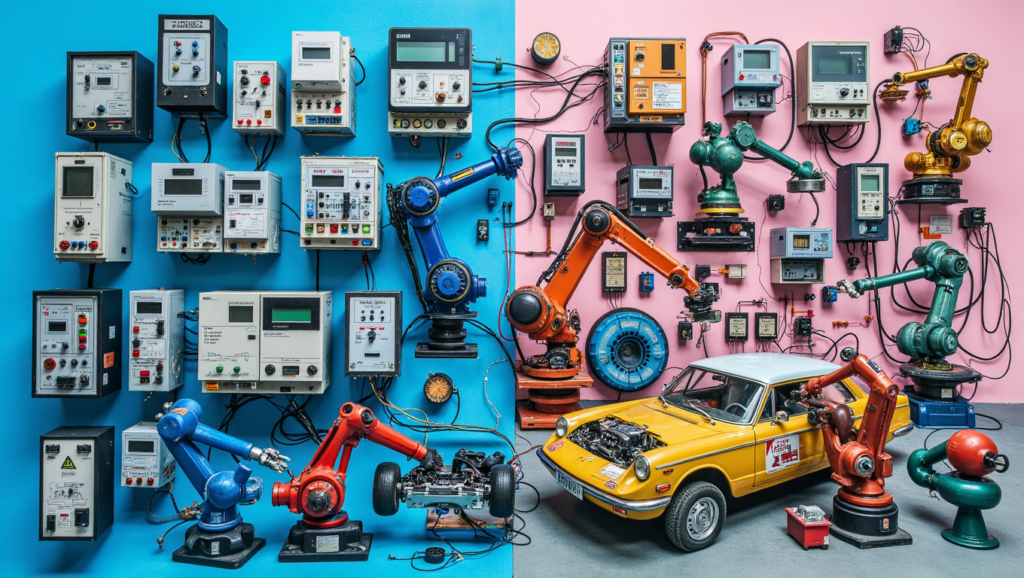
A common real-life example of PLC use in robotics is an automobile assembly line. In such a system, PLCs coordinate multiple robotic arms that perform welding, painting, and component installation. The PLC ensures that each robot starts its task only when the previous step is completed and safety conditions are met. If a sensor detects a fault, such as a missing part or abnormal position, the PLC immediately stops the system to prevent damage or accidents.
Another example is in packaging and palliating robots used in food and beverage industries. PLCs control conveyor belts, robotic pick-and-place arms, and sorting mechanisms, ensuring products are packaged accurately and at high speed.
Applications in Robotics
PLCs are widely applied in industrial robotics, especially where reliability and continuous operation are critical. They are used for robot sequencing, interlocking multiple machines, and managing production workflows. In process automation, PLCs control robotic systems involved in chemical processing, bottling, and material handling.
In collaborative robotics, PLCs play a key role in safety monitoring and coordination between humans and robots. In educational and training robots, PLCs help students learn industrial control logic and automation principles. Even in smart factories, PLCs integrate with sensors, robots, and data systems to support Industry 4.0 concepts.
Conclusion
Programmable Logic Controllers are a backbone technology in robotics, especially in industrial and automation-focused applications. Their reliability, real-time control, and ease of programming make them ideal for managing robotic systems. By linking sensors, logic, and actuators, PLCs enable robots to work efficiently, safely, and consistently in real-world environments.