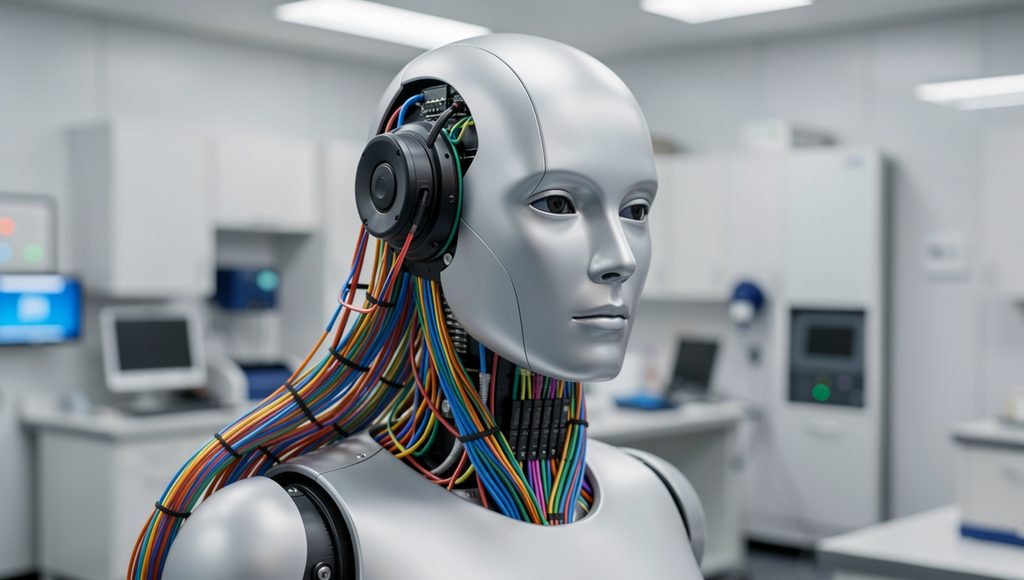
Speech Recognition in Robots
Learn how robots use speech recognition to understand spoken commands, interact with people, and perform intelligent tasks.
Speech recognition in robots is the process of converting human speech into digital information that a robot can analyze and use. It allows robots to receive spoken instructions such as “move forward,” “pick up the object,” or “turn left.”
Speech recognition is an important part of human-robot interaction. When combined with natural language processing, sensing, planning, and robot control, it can make robots easier for people to communicate with.
How Speech Recognition Works in Robots
A speech-enabled robot generally follows several stages to convert a person’s voice into an actionable robot command.
Role of Microphones
Microphones provide the robot with an electronic representation of human speech. A simple robot may use a single microphone, while more advanced robots can use multiple microphones arranged as an array.
Microphone arrays can help robots determine the direction from which a person is speaking. This can be useful when several people are present in the same environment.
Noise Handling
Robots often operate in environments containing background noise. Motors, fans, machinery, conversations, traffic, and other sounds can make speech recognition difficult.
Common Audio Challenges
- Background conversations
- Mechanical and motor noise
- Echo and room reflections
- Distance between speaker and robot
- Different accents and speaking styles
- Low-volume or unclear speech
Speech Recognition and Natural Language Processing
Speech recognition primarily answers the question: “What was spoken?” Natural language processing can then help answer: “What does the speaker want the robot to do?”
For example, if a person says, “Please bring me the blue cup,” the speech-recognition system may convert the voice into text. The robot’s language-processing system can then identify the requested object, its color, and the desired action.
Example Robot Command
Human: “Move to the kitchen.”
Speech Recognition: Converts the spoken command into recognized words.
Language Understanding: Identifies “move” as the action and “kitchen” as the destination.
Navigation System: Plans a route to the kitchen.
Robot Controller: Drives the robot along the planned route.
Applications of Speech Recognition in Robots
- Service Robots: Receiving spoken instructions from users.
- Healthcare Robots: Supporting communication and assistance tasks.
- Educational Robots: Allowing students to interact with robots through voice.
- Industrial Robots: Supporting selected voice-based commands and operator interaction.
- Domestic Robots: Responding to household commands.
- Social Robots: Creating more natural conversations with people.
- Mobile Robots: Accepting spoken navigation and task commands.
Advantages
- Provides a natural method of interacting with robots.
- Reduces dependence on physical buttons and controllers.
- Can improve accessibility for some users.
- Allows hands-free interaction.
- Can make service and social robots easier to operate.
- Supports more intuitive human-robot interaction.
Limitations
- Recognition accuracy can decrease in noisy environments.
- Different accents and pronunciations can create challenges.
- Multiple people speaking simultaneously can confuse the system.
- Very fast or unclear speech can be difficult to recognize.
- Some commands require additional language understanding before execution.
- Speech recognition alone does not provide complete robot intelligence.
Speech Recognition in Autonomous Robots
In an autonomous robot, speech recognition can become one input channel among many. The robot may combine spoken commands with cameras, distance sensors, localization, mapping, and other perception systems.
For example, a user could tell a mobile robot to “go to the laboratory.” The robot can interpret the command, determine the destination, plan a path, avoid obstacles, and navigate to the requested location.
Future of Speech-Enabled Robots
Future robots are expected to combine speech recognition with improved language understanding, visual perception, contextual reasoning, and autonomous decision-making. This could allow robots to understand more natural instructions rather than relying only on fixed commands.
A major goal is to create robots that can understand not only individual words but also the context, intent, and environment associated with a person’s request.
Speech Recognition and Human-Robot Interaction
Speech recognition is particularly valuable in human-robot interaction because speech is one of the most familiar communication methods for people. A robot that can listen and respond appropriately can provide a more accessible and natural interface.
To learn more about robotics engineering topics, visit the Robotics Engineering Courses home page.
Quick Quiz
1. What is the main purpose of speech recognition in a robot?
2. Which component captures a person’s voice?
3. Why is noise reduction important?
Explore more robotics engineering learning resources at:
roboticsengineeringcourses.com