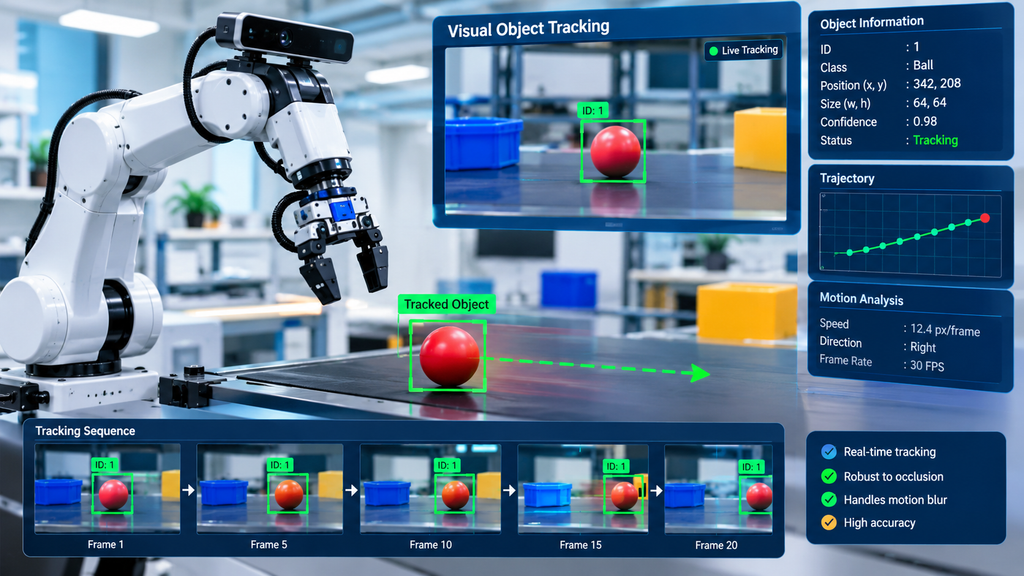
Visual Object Tracking in Robotics
Understanding how robots detect, follow, and continuously monitor moving objects using cameras and intelligent vision algorithms.
What Is Visual Object Tracking?
Visual Object Tracking is a robotics vision technique that allows a robot to locate and follow a particular object as it moves through a scene. A camera captures a sequence of images or video frames, while a tracking system determines where the target object is located in each frame.
Unlike simple object detection, which identifies objects independently in individual images, object tracking maintains information about the same target over time. This makes tracking important for mobile robots, autonomous vehicles, robotic arms, surveillance robots, and human-robot interaction.
How Visual Object Tracking Works
A typical robotic tracking system follows a sequence of perception and decision-making steps. The camera continuously provides visual information, and the tracking algorithm updates the target’s position as the scene changes.
Major Components of a Tracking System
Camera
Cameras provide the visual data required by the robot. Depending on the application, a robot may use a standard RGB camera, stereo camera, depth camera, or multiple cameras.
Object Detection
The system first needs to determine which object should be tracked. Detection can identify objects such as people, vehicles, tools, packages, or other robots.
Tracking Algorithm
The tracking algorithm estimates the target location in successive frames. It attempts to maintain the identity of the target even when the object changes position, scale, or appearance.
Robot Controller
After obtaining the target position, the robot controller can use that information to move the robot, rotate a camera, control a robotic arm, or perform another action.
Common Visual Tracking Methods
Feature-Based Tracking
Feature-based methods track distinctive visual features such as corners, edges, textures, or patterns. They can be useful when the target has recognizable visual features.
Template Tracking
Template tracking compares a stored representation of an object with regions of new video frames to determine where the object has moved.
Optical Flow
Optical flow estimates apparent motion between consecutive frames. It can help robots understand how objects and visual features are moving.
Deep Learning Tracking
Modern tracking systems can use neural networks to learn visual representations and maintain object identity across changing video frames.
Visual Tracking and Robot Motion
Object tracking becomes especially useful when the robot must physically respond to a moving target. For example, a mobile robot following a person can use the target’s image position to determine whether it should move forward, turn left, or turn right.
A robotic arm can similarly track a moving component on a conveyor belt and adjust its position before attempting to grasp it.
Applications of Visual Object Tracking
Mobile Robots
Robots can track people, vehicles, objects, or other robots while navigating an environment.
Autonomous Vehicles
Tracking helps autonomous systems continuously monitor nearby vehicles, pedestrians, and other road users.
Robotic Arms
Industrial robots can track objects moving along production lines before picking, sorting, or assembling them.
Human-Robot Interaction
Service robots can track human movement to maintain awareness of a person’s location.
Warehouse Robots
Tracking can help warehouse robots monitor packages, containers, workers, and moving equipment.
Security Robots
Autonomous security robots can track selected objects or people while moving through monitored areas.
Challenges in Visual Object Tracking
Reliable visual tracking can be difficult because real-world environments are constantly changing.
- Occlusion: The target may temporarily disappear behind another object.
- Lighting changes: Brightness and shadows can alter the target’s appearance.
- Fast motion: Rapid movement can cause motion blur or tracking errors.
- Scale changes: A target may appear larger or smaller as it moves toward or away from the camera.
- Background similarity: Objects can become difficult to distinguish when their appearance resembles the background.
- Multiple objects: Similar-looking objects can make identity tracking more difficult.
- Computational requirements: Advanced vision models may require significant processing power.
Visual Object Tracking vs Object Detection
| Feature | Object Detection | Object Tracking |
|---|---|---|
| Main purpose | Find objects in an image or frame | Follow an object across multiple frames |
| Time information | Usually frame-based | Uses information over time |
| Identity | May not maintain identity | Attempts to maintain target identity |
| Robot use | Scene understanding | Following and responding to moving targets |
Why Visual Object Tracking Is Important in Robotics
Robots operate in environments where people, vehicles, machines, and other objects may continuously move. A single image provides limited information about movement. Tracking allows a robot to understand how a target changes position over time.
By combining visual tracking with navigation, motion planning, and control, robots can make more informed decisions and interact with dynamic environments.
Students interested in robotics vision can explore more educational material through Robotics Engineering Courses .
Future of Visual Object Tracking
The future of robotic visual tracking is closely connected with artificial intelligence, real-time vision processing, depth perception, and autonomous decision-making. More capable tracking systems can help robots understand dynamic environments with greater reliability.
As robotic hardware becomes more powerful, visual tracking can be integrated with navigation and intelligent control to support increasingly autonomous machines.
Learn More About Robotics
Explore additional robotics engineering topics, lessons, and educational resources.
Visit Robotics Engineering Courses