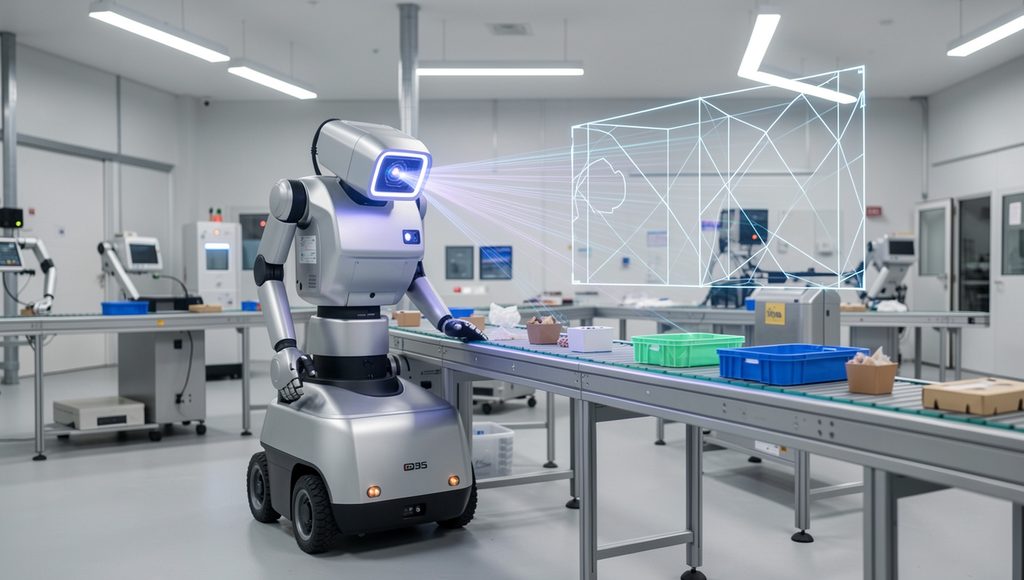
Vision Sensors in Autonomous Robots
Vision sensors give autonomous robots the ability to observe their surroundings, detect objects, estimate distance, recognize visual patterns, and support intelligent navigation.
What Are Vision Sensors?
Vision sensors are sensing devices that allow autonomous robots to collect visual information about their environment. Cameras and other vision technologies provide information that robotic systems can analyze using computer vision and artificial intelligence.
Unlike simple proximity sensors that may only indicate whether an object is nearby, vision sensors can provide detailed information about the appearance, position, shape, and movement of objects.
Vision sensors are therefore an important part of many autonomous robots used in manufacturing, transportation, warehouses, agriculture, inspection, and service robotics.
Explore more robotics engineering topics at Robotics Engineering Courses .
Types of Vision Sensors
Different autonomous robots require different types of visual sensing. Common vision sensors include cameras, stereo systems, depth cameras, infrared sensors, and specialized 3D vision devices.
RGB Cameras
RGB cameras capture color images of the environment. Robots can analyze these images to identify objects, signs, surfaces, people, and other visual features.
Stereo Cameras
Stereo cameras use multiple viewpoints to estimate depth. They help robots determine the three-dimensional position of objects.
Depth Cameras
Depth cameras provide distance information in addition to visual information. They are useful for obstacle detection, navigation, and object manipulation.
Infrared Cameras
Infrared vision can provide useful information in low-light environments and can help detect objects based on infrared radiation.
Event Cameras
Event cameras detect changes in brightness rather than producing conventional images at fixed intervals. They can be useful for high-speed robotic applications.
3D Vision Sensors
3D vision sensors provide spatial information about objects and surfaces, helping robots understand the geometry of their surroundings.
Functions of Vision Sensors
Vision sensors can support several important functions in autonomous robots. The visual information can be processed by computer vision algorithms before being passed to the robot’s decision-making and control systems.
- Object Detection: Locating objects within an image or scene.
- Object Recognition: Identifying what a detected object represents.
- Obstacle Detection: Detecting objects that may block the robot’s path.
- Depth Estimation: Estimating the distance between the robot and objects.
- Object Tracking: Following the movement of people, vehicles, or other objects.
- Scene Understanding: Interpreting important features of the surrounding environment.
- Navigation Support: Providing visual information that helps a robot select and follow a path.
Vision Is More Than a Camera
A camera only captures visual data. Autonomous robot vision requires additional processing to turn that data into useful information. Image processing, computer vision, machine learning, and artificial intelligence can help a robot interpret what its sensors observe.
Applications of Vision Sensors
Vision sensors are used in many autonomous robotic systems. Their ability to provide detailed environmental information makes them valuable for navigation, inspection, manipulation, and decision-making.
| Application | Role of Vision Sensors |
|---|---|
| Autonomous Vehicles | Detecting roads, vehicles, pedestrians, traffic features, and obstacles. |
| Warehouse Robots | Recognizing packages, shelves, pathways, and obstacles. |
| Delivery Robots | Detecting sidewalks, people, vehicles, obstacles, and navigation landmarks. |
| Agricultural Robots | Identifying plants, crops, weeds, and agricultural conditions. |
| Inspection Robots | Detecting cracks, defects, damage, and unusual surface conditions. |
| Service Robots | Recognizing people, objects, rooms, doors, and indoor pathways. |
| Humanoid Robots | Supporting object recognition, human interaction, and environmental understanding. |
Vision Sensor Workflow in Autonomous Robots
A typical vision-based autonomous robot follows a sequence of sensing, processing, interpretation, decision-making, and movement.
Advantages of Vision Sensors
- Provide rich information about the environment.
- Help robots identify and classify objects.
- Support autonomous navigation.
- Enable visual object tracking.
- Support obstacle detection and avoidance.
- Can provide color, shape, texture, and spatial information.
- Work together with artificial intelligence systems.
- Support advanced robotic perception.
Challenges of Vision Sensors
Vision systems can be affected by changing environmental conditions. Bright sunlight, darkness, shadows, reflections, fog, motion blur, camera vibration, and object occlusion can make visual interpretation more difficult.
Autonomous robots may therefore combine vision sensors with other sensing technologies. Combining information from multiple sensors can improve the reliability of perception and decision-making.
Vision Sensors for Autonomous Navigation
Vision sensors can help an autonomous robot understand where it is and what is around it. A robot can use visual landmarks, environmental features, obstacles, and depth information to support navigation.
Vision can also contribute to mapping and localization. When combined with suitable algorithms, visual information can help a robot estimate its position while moving through an environment.
This makes vision especially valuable for robots operating in warehouses, roads, homes, factories, farms, and other changing environments.
Explore More Robotics Topics
Learn more about robotics engineering, robot vision, autonomous systems, sensors, and intelligent robots.
Visit Robotics Engineering Courses