Motor Driver
Motor Driver — DIY Obstacle-Avoiding Robot
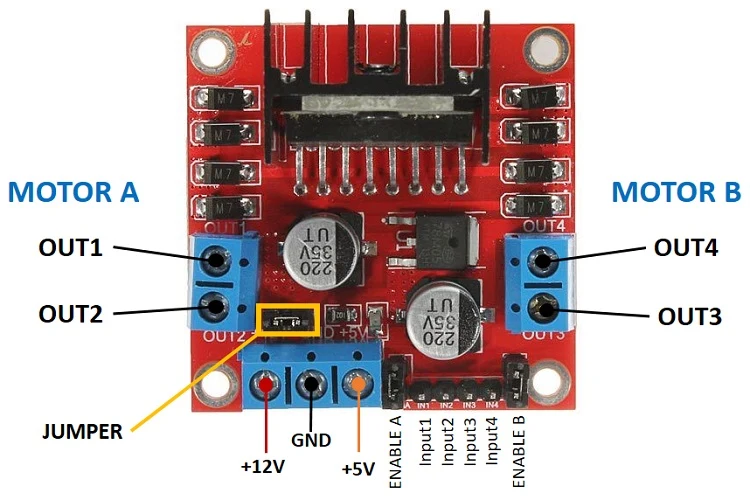
The Motor Driver is an important part of a DIY obstacle-avoiding robot because it controls the motors according to commands from the robot’s microcontroller. A common motor driver allows the controller to switch the motors ON/OFF and change their direction and speed. Since a microcontroller cannot normally supply enough current to drive DC motors directly, the motor driver acts as an interface between the controller and the motors.
In an obstacle-avoiding robot, the motor driver receives movement commands based on information from the distance sensor. For example, when the path is clear, it can drive both motors forward. When an obstacle is detected, the controller can command the driver to stop one motor or reverse the motors, allowing the robot to turn and find another path. This makes the motor driver essential for accurate forward, reverse, left, and right movement.
For a simple DIY project, motor-driver modules such as an L298N or similar dual-channel driver can be used with two DC geared motors. The driver is connected to the robot’s controller, motor power supply, and two motors. Proper motor-driver selection should consider motor voltage, maximum current, heat dissipation, and the robot’s battery capacity.